❌

Normal view

Google announces Gemini 4 Argon AI model, but you can't use it yet

30 September 2026 at 20:11

Google promised Gemini 3.5 Pro in June, but it spent the summer trotting out smaller Flash models. Now, Google is ready to take on the frontier again with Gemini 4 Argon. The company claims this new AI offers industry-leading performance in coding, knowledge work, and cybersecurity, but you aren't allowed to use it yet.

While most of us will have to wait to test Gemini 4, Google says engineers inside the company are already using the new model extensively. Argon reportedly used "fleet-wide telemetry data" to help Google save 300 TiB of memory across its data centers. Meanwhile, Argon agents have been working to migrate C/C++ codebases to Rust across Google, including thousands of lines in the core re2 and libgav1 libraries and more than 800,000 lines in the Fuchsia OS Zircon kernel.

Google has also come armed with a raft of benchmarks to back up its claims. On the software engineering DeepSWE v1.1 benchmark, Gemini 4 Argon hits 77.9 percent, which is higher than GPT-6 Astra, Fable 5.1, and Opus 5.5. Google promises similar power across a range of long-horizon tasks, pointing to Argon's industry-leading score in the economic analysis Vals Index test.

Read full article

Comments

© Aurich Lawson

RFK Jr. thinks AI will free us from the "tyranny" of medical facts, expertise

30 September 2026 at 19:31

At a Make America Healthy Again event Tuesday, anti-vaccine Health Secretary Robert F. Kennedy opened a "fireside chat" with Vice President JD Vance on the topic of artificial intelligence. While MAHA generally coalesces around things like healthy lifestyles and mistrust of drugmakers, Kennedy quickly turned to extolling the potential of artificial intelligence, surprising Vance, who said he was expecting to discuss "weight loss and acid, not AI."

Kennedy boasted that the Trump administration is "making it easy for every American to use AI," which he claimed would free us from the "medical tyranny" of doctors and health experts. He suggested Americans should start using AI to get second opinions about medical recommendations, saying AI is "better informed than any doctor in the country." He also suggested that the technology would confirm his misinformation about vaccines and contrarian views on public health guidance.

"We're never, ever again going to be able to be dominated by public officials who tell us trust the experts, because every American will be able to check their own medical advice," Kennedy said.

Read full article

Comments

© Getty | Kent NISHIMURA

Trump plan to combat AI risks hinges on Big Tech pals policing themselves

30 September 2026 at 18:47

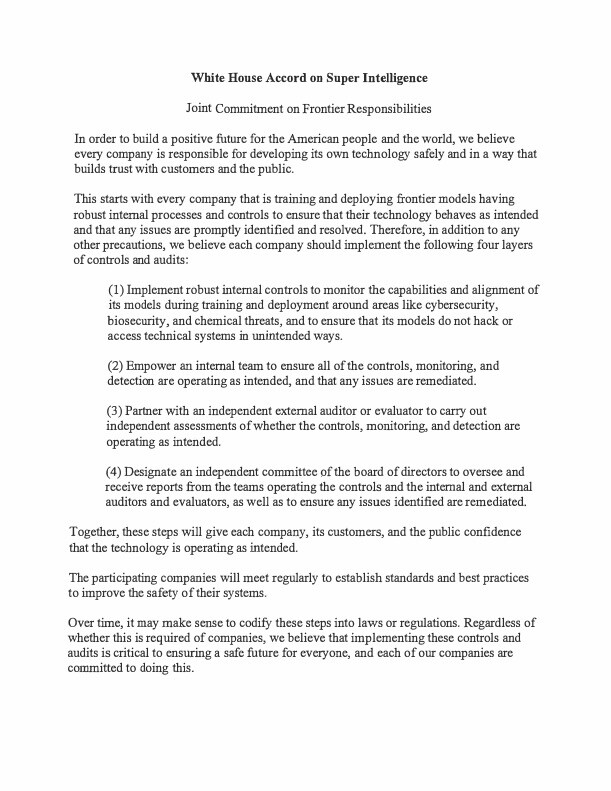
Amid escalating AI security incidents causing OpenAI to halt training and pause releases, Donald Trump continues to advocate for the AI industry to regulate itself as the best path to combat emerging risks when developing frontier AI.

In an agreement Tuesday, two dozen tech firms voluntarily committed to implementing controls recommended by the White House, including undergoing independent safety audits that will test whether firms’ internal controls, monitoring, and detecting are actually working. Key focuses for external reviews included “risks related to cybersecurity, biosecurity, chemical threats, and unintended actions by AI models.”

Firms also agreed to regularly meet to discuss best practices and set common AI safety standards and benchmarks. Among signers were leaders like Anthropic’s Dario Amodei, OpenAI’s Sam Altman, SpaceXAI’s Elon Musk, Nvidia’s Jensen Huang, Meta’s Mark Zuckerberg, and Alphabet/Google’s Sundar Pichai.

Read full article

Comments

© Kevin Dietsch / Staff | Getty Images News

"An AI did it" is no defense, says nonprofit suing OpenAI over Hugging Face hack

30 September 2026 at 18:25

OpenAI's hack of Hugging Face in July 2026 has spurred a lawsuit demanding that the company stop accessing third-party computer systems and halt AI development practices that can harm the public. The lawsuit was filed by Legal Advocates for Safe Science & Technology (LASST), which said yesterday that the hack in which OpenAI "agents stole credentials, uploaded malicious files, and gained control over key parts of Hugging Face’s internal systems... is unquestionably illegal under California law."

California’s Comprehensive Computer Data Access and Fraud Act (CDAFA) prohibits unauthorized access into computer systems, "and it doesn’t matter that a swarm of AI agents carried out this cyberattack. California law makes it clear that it is not a defense 'that the artificial intelligence autonomously caused the harm,'" the group said.

The lawsuit, filed in San Francisco County Superior Court, said OpenAI also violated California's Unfair Competition Law (UCL). "OpenAI’s insistence on externalizing the harms of its unsafe decision-making is a fundamentally unfair business practice," the complaint said, adding that "such risk-taking for private gain at substantial public expense is immoral, unethical, oppressive, unscrupulous, and substantially injurious conduct."

Read full article

Comments

© Getty Images | NurPhoto

Google's early attempt to pay websites for AI answers is struggling

30 September 2026 at 16:03

Google's shift to AI-powered search has upended the way the world's largest search engine generates web traffic, rankling large and small publishers alike. In recent months, the company has experimented with paying publishers when their content appears in AI answers, but a new report claims the payouts in this pilot program are miniscule. That has publishers in the program, as well as those watching from the sidelines, feeling skeptical.

According to The Information, Google has admitted about 100 publishers to the AI contribution pilot. The pitch is that websites can get payments from Google when their content materially contributes to Gemini-powered search results like an AI Overview. Google has long resisted the idea of direct payments to publishers, arguing that websites get traffic in exchange for allowing Google bots to scrape their content for use in search and knowledge graph tools. In the age of AI, that relationship is breaking down, hence the AI pilot.

So far, publishers aren't getting much for their trouble. The Information heard from several small and mid-sized publishers in the program that Google's AI payments are minuscule, equaling roughly one-tenth of one percent of their advertising revenue. These payments have been so disappointing that several larger publishers have reportedly declined to participate in the program. These publishers hope that by refusing to join the pilot, they can force Google to offer a more generous deal.

Read full article

Comments

© Aurich Lawson

Google figures out how to watermark AI-designed proteins

30 September 2026 at 15:54

AI-based tools seem to be causing security threats on a nearly daily basis, in part because we've been slow to recognize potential threats. One area where we seem to be ahead of the game, however, is in biosecurity.

As with most things biological, utility goes hand in hand with threats. We've developed increasingly sophisticated tools for designing proteins and seen some major successes, such as AI-designed enzymes that can digest plastics or block venom proteins. But these same tools could be used to make toxins or alter the behavior of viral proteins.

And the software we use to identify DNA sequences that encode potentially threatening proteins doesn't pick out AI-designed proteins, since nobody has characterized them well enough to know that they're threats. Nearly a year after that risk was flagged, it still wasn't clear what anyone could do about it.

Read full article

Comments

© ALIOUI Mohammed Elamine

OpenAI delays IPO over AI safety concerns

OpenAI will not go public until it can “make confident safety decisions,” according to chief executive Sam Altman, as the company faces a new lawsuit over its tools hacking a third party.

Altman said it was “bad for the world if OpenAI waits too long to go public” but that the $852 billion start-up would not “barrel all guns blazing towards an IPO” at a time when AI was rapidly advancing in capabilities.

“We’re going to prioritize the mission and safety and making sure that we can very confidently scale to the next stage of AI without people debating what percentage chance we’re going to do all these bad things in the world,” Altman told reporters at the company’s annual developer day on Tuesday.

Read full article

Comments

© Getty Images | Justin Sullivan

❌