"Rendering Doom in a database is obviously a bad idea," Lukas Vogel writes in a lengthy blog post explaining how exactly he managed to render Doom using an SQL database.
OK, that's not entirely accurate. The SQLDoom project uses a small Python client to handle input and output, drive the game's timing, and display each frame to the screen. Behind that, a series of CedarDB tables tracks the game geometry and state, while about 1,300 lines of SQL queries spread across 89 common table expressions implement the game logic and generate 35 bitmap framebuffers per second.
In this, SQLDoom is a major improvement over Vogel's previous DoomQL project, which last year set out to build "a multiplayer Doom-like shooter entirely in SQL." Unfortunately, that effort ended up with raycasting-based, grayscale ASCII graphics that were more akin to the simplistic 90-degree-angled maps of Wolfenstein 3D. The newer SQLDoom, on the other hand, generates full-color 640x480 frames that look like they could have come from the original Doom executable.
On Friday, Amazon committed to donating more than $1 billion over the next five years to communities neighboring data centers.
In a press release, Amazon Web Services’ CEO Matt Garman said that communities would decide how to prioritize funds across “education, job training, energy affordability, water, and energy preservation, and local priorities.”
Laying out other community commitments, Amazon also promised to ensure data centers wouldn’t increase power bills or wipe out local water supplies. Regarding the latter, Amazon promised to be “water positive” by 2030, while claiming that 75 percent of projects have already met this goal.
COVID-19 made the weaknesses in our pandemic preparedness at national and global levels painfully clear. But a new study highlights that even at the first, local steps of an outbreak with pandemic-potential, we are worryingly underprepared.
Health officials in New York set up a regional test of healthcare facilities to identify and respond to a patient with a mystery infection that could pose a pandemic-level threat. But things didn't go well. Overall, responses were slow, appropriate use of personal protective equipment was spotty, and only 60 percent of facilities passed the basics of the test—an overall failing grade.
"These drills identified needs for health care workers and health care facility staff member training to achieve earlier identification, masking, and isolation of potentially infectious febrile patients," the officials wrote in the study, which was published in the Morbidity and Mortality Weekly Report.
California’s attorney general and three city attorneys announced a $272.5 million settlement with Lyft after allegations that the company “committed wage theft by misclassifying drivers as independent contractors rather than employees” between 2016 and 2020, according to a Thursday statement.
The case dates back to May 2020, when then-Attorney General Xavier Becerra, who is now the Democratic candidate for governor, sued both Uber and Lyft. That lawsuit said the ridehailing companies evaded state law when they declared that their drivers were not employees.
Thursday’s settlement affects only Lyft, while the case against Uber continues.
One argument that often comes up about climate change is that fossil fuels are good because they powered economic growth that has left most people better off overall. And, to an extent, that has been true, but it's also an extremely limited perspective.
It's pretty obvious now that the growth they powered has come with very high costs that we've only recently started to pay, in the form of damages and disruptions from extreme weather events. With things like sea level rise expected to continue for centuries even if we hit net zero, it's difficult to estimate how expensive that growth will eventually be.
But that perspective is also limited: We now have better ways to power our growth—ways that are less environmentally damaging now and won't leave our descendants with a carbon debt that will be difficult to manage.
The US has arrested another suspect accused of smuggling high-end computer servers containing export-controlled Nvidia chips into China.
In a press release on Thursday, the Department of Justice accused 38-year-old Greg Lui of using false paperwork to mask shipments of servers worth more than $300 million that he allegedly knew were ultimately destined for China.
As the CEO of Earthmade Computer, Lui allegedly conspired with freight-forwarding firms in South Asian countries like Malaysia and Singapore to illegally divert chip shipments into China, including Nvidia’s A100 GPUs and H100 GPUs, the FBI’s indictment alleged. These are not Nvidia’s most advanced chips. However, the chips can process large amounts of data and train large language models, which the US fears could pose national security risks if China suddenly gets access to enough chips to drastically advance its AI or strengthen its military.
It’s a regrettable reality that there is never enough time to cover all the interesting scientific stories we come across. So every month, we highlight a handful of the best stories that nearly slipped through the cracks. September’s list includes a tantalizing hint of the elusive dark matter at the LUX-ZEPLIN detector; entangled Z bosons at the Large Hadron Collider; possible use of psychoactive substances in the Late Pleistocene; and an intriguing technical description of a telescope attributed to Galileo.
A hint of dark matter?
Physicists believe dark matter makes up roughly 85 percent of matter in our universe, with the strongest (but not only) candidate being so-called weakly interacting massive particles (WIMPs). But directly detecting WIMPs, or other alternative hypothetical dark matter particles, has eluded physicists for decades. We might have our first glimpse, however, courtesy of the LUX-ZEPLIN detector buried deep in a gold mine in South Dakota. Those potentially exciting results were presented in a scientific talk at the 2026 TeV Particle Astrophysics conference in Japan, with a preprint available on the arXiv. (It has been submitted to Physical Review Letters for peer review.)
The announcement came with strong caveats: the signal is just a hint, well below the threshold needed to confirm discovery, and might just be a statistical fluke. Anyone who regularly follows dark matter news knows that past tantalizing anomalies evaporated as more data came in. But the LUX-ZEPLIN team was unable to account for this event and decided to report their result to the broader physics community. They are still collecting data, as is the XENONnT at the Gran Sasso National Laboratory in Italy. And China's PandaX detector is currently being built.
In late 1970, a Titan IIIC rocket launched from Space Launch Complex 40 at what was then called Cape Canaveral Air Force Station. It carried a top-secret payload for the US military.
Much has changed in spaceflight since then. The Titan IIIC would bow out in 1982 after dozens of launches. Various Titans continued launching from Space Launch Complex 40 until 2005, at which point the US Air Force—in a competitive process hotly opposed by United Launch Alliance—turned the pad over to a small, largely unknown startup called SpaceX. And Cape Canaveral is now a "Space Force" station.
But those unspecified payloads? Until last month, some of them were still flying operationally.
My family has spent four summers participating in demand response programs whereby utility companies pay customers to reduce energy use on the hottest summer days. Most summers have involved carefully precooling our New York City apartment before switching off the air conditioners and sweating it out during the designated demand response periods.
But this year, we kept our window air conditioners running throughout a heat dome event that drove daytime temperatures into the triple digits and made the nights oppressively hot. The difference was that we powered the air conditioners through two household batteries tucked away unobtrusively in the corners of our living room and bedroom.
We were among about 1,000 New York City households that took part in a free and growing program offered by the local startup Every Electric. The company’s proposition is simple: Get one or more batteries delivered to your home, plug the batteries into a standard wall electrical outlet, and then plug your window air conditioners into the batteries. Households can keep running air conditioners as usual during peak demand periods while also earning money through the local demand response program with the utility company Con Edison.
Tesla sold 486,532 electric vehicles during the third quarter of 2026. That’s a 2.1 percent decrease on the same quarter in 2025, when the company found homes for 497,099 EVs, and one might think that would be bad news for a company valued on the premise of near-constant growth.
But Tesla stock is up this morning; the year-over-year numbers might look bad, but the company still exceeded analysts’ expectations of 456,600 cars, which would have been a larger 8 percent year-on-year decline
Total production at Tesla actually increased year over year; it built 464,391 vehicles—a 3.7 percent increase—457,387 of which were Models 3 and Y (a 4.9 percent increase year over year). The remaining 7,004 were other models, mostly Cybertrucks, with presumably some Semis and Cybercabs, as the Models S and X are now retired; this category saw a 39.8 percent decrease year over year.
The era of generative AI has upended technology supply chains, and there is one ironclad rule in 2026: If it has memory or storage, it's getting more expensive. Even devices with years-old tech inside are still apparently subject to that unwritten rule. Nvidia has just announced that the Shield TV Pro is getting $100 more expensive, effective immediately.
The most recent version of the Shield streaming box debuted in 2019, running Android TV with AI upscaling and hardware decoding for almost any type of media. While it ran an aging Tegra X1+ processor, that was (and still is) fast for a TV media streamer. The device launched at $199.99, with a non-Pro variant at $149.99. The non-Pro Shield has since been discontinued, but the Shield TV Pro lives on at the new $299.99 price.
Nvidia has confirmed that you can blame AI for the higher Shield TV pricing. "Starting October 2, SHIELD Pro will be priced at $299. The cost of components, including memory, has increased substantially across the industry," a spokesperson told Ars.
This week, SpaceX celebrated the first orbital launch of its new Starship rocket. I'm not sure many people, at least those outside of SpaceX, expected it to take 14 flights of Starship before it technically reached low-Earth orbit, but Monday morning's launch finally added that to SpaceX's list of accomplishments with its new super-heavy rocket. Starship had gone 99 percent of the way to orbit before, only held back by safety concerns around the possibility of stranding the huge rocket in space.
What was most notable for SpaceX with this Starship flight was that it unlocked a massive growth potential for Starlink, with the first 26 of the network's new-generation Starlink V3 satellites successfully deployed Monday.
It's a question that sounds like it should have a simple answer. But it's now at the center of a lawsuit between two of the biggest names in TVs, with TCL accusing its longtime competitor Samsung of falsely advertising budget LCD-LED TVs as Mini LED sets.
TCL may have a point. Samsung's M-series TVs, which range from $300 for a 43-inch model to $2,300 for a 100-inch model, do raise some legitimate questions about what should qualify as Mini LED. More broadly, though, the dispute highlights a problem for shoppers: Without agreed-upon standards for what "Mini LED" actually means, manufacturers have plenty of room to define the technology for themselves.
Venus is shrouded in a veil of mystery. The yellowish “lower haze” at the bottom of its atmosphere was discovered by the Venera and Pioneer Venus probes in the 1970s. These spacecraft were some of the first to successfully send images of the planet back to Earth, but the haze they saw went unexplained for decades. Now the mystery Venus was keeping has been unveiled.
What nobody knew then was that the haze is an accumulation of particles from meteorites. “Shooting stars” that burn up in the atmosphere leave behind cosmic dust particles, and after sulfuric acid interacts with these particles, it leaves behind a haze. Planetary scientist Hiroki Karyu and his research team at Tohoku University in Sendai City, Japan, finally figured out how the haze formed using a microphysical model. This type of model involves microphysics—the micro-scale processes that create clouds and precipitation on Earth and other bodies.
“The continuous influx of cosmic dust is sufficient to sustain this lower haze layer with the particle size distribution observed by the entry probes,” Karyu said in a study published in Nature Astronomy. “These haze particles of cosmic origin act as efficient condensation nuclei, promoting cloud formation in the main cloud deck even far from their initial source.”
A four-person crew rocketed into orbit Thursday from Cape Canaveral Space Force Station, Florida, heading for a six-month expedition on the International Space Station.
Riding a Falcon 9 rocket and Dragon spacecraft, the four crew members departed from Space Launch Complex-40 at Cape Canaveral at 11:10 am EDT (15:10 UTC) Thursday. Nine minutes later, they were in orbit to begin closing in on the space station for docking Thursday evening.
The launch was delayed from mid-September to replace a balky valve in the Dragon spacecraft's propulsion system, a task that involved cutting into a propellant line inside the ship to swap out a faulty component.
The Pentagon is informing more than 2 million current and former military members that their personnel records storing sensitive personal information were stolen over a monthslong compromise of one of its networks. The breach is the second one in recent months to expose sensitive government information.
The records, according to one notification letter posted to Reddit, included Social Security numbers, names, addresses, sex, race, and occupational specialty. This last category could be particularly valuable to foreign adversaries because it could help their intelligence agencies in identifying high-value military personnel. Starting last October, hackers gained access to a system operated by the Defense Manpower Data Center, which collates Department of Defense personnel records. The Pentagon says that the breach compromised the records of 2.8 million living individuals.
A potential boon
The incident is the second time a major network breach in recent months has exposed sensitive US government personnel records that criminal groups or foreign adversaries could use. Last month, the ransomware group ShinyHunters claimed it hacked into FBI systems and stole records of thousands of the agency’s current or former employees. Reuters reported the job titles in the records included ones related to investigating China or Russia.
In a setback for publishers worried about the effects of AI search, a US federal judge has dismissed lawsuits filed by Chegg and Penske Media against Google. The companies accused Google of antitrust violations in products like AI overviews, which have led to decreasing traffic at numerous sites. However, US District Judge Amit Mehta has ruled that Google's conduct is not illegal under antitrust law.
The lawsuits were filed in 2025, and Google requested a dismissal earlier this year. Chegg, an education and learning platform, claimed in its lawsuit that Google illegally scraped its educational content. This allowed Gemini models to essentially recreate that content and reduce the site's traffic. Penske, which owns publications like Rolling Stone and Variety, filed a similar case that alleged lost traffic. Specifically, the publisher claimed it was unfair that sites indexed for organic search would also have their content harvested for AI answers, with no way to opt out.
These arguments did not sway the judge, who noted that Google's implicit agreement with websites is not legally relevant. "Plaintiffs have pleaded only that they have an ‘expectation’ that Google will send them search traffic if they make their content available for free," wrote Mehta. "But an expectation is not an agreement. It is simply how a general search engine works."
Humans can be a frisky bunch, and it wasn’t very long after Tesla Autopilot started letting drivers go hands-free before people decided to post footage of themselves having sex from the driver’s seat. Recently, The San Francisco Standard interviewed multiple people who claimed to have had sex in robotaxis belonging to General Motors’ now-defunct Cruise. “There’s no one to tell you, 'You can’t do that.' It gets to the point where you’re more and more and more comfortable, and if you’re with someone, like a more serious partner, it can escalate to other activities,” one man told SF Standard.
“The interiors of vehicles has been sexualized and appropriated for sex since forever in popular culture. You can see it in movies, you can see it in lyrics, you can see it in photography,” said Alexandros Rouchitsas, a human factors/UX researcher and one of the organizers of a recent workshop, “Love in Traffic,” that brought researchers from academia and industry together in late September in Sweden to consider how design can help the problem.
A growing problem?
One difference between a robotaxi and a human-driven ride is the removal of the social obligation to interact with a human driver. There’s no need to make small talk, and you won’t have to listen to someone’s terrible opinion, which can lead to riders assuming far more privacy than the cameras and ridership terms and conditions provide. That's a lesson that a pair of teens who hired a Waymo, spent their ride getting drunk, and shot gel beads out the windows learned the hard way this summer.
With its premiere just two weeks away, Marvel Studios has dropped one last trailer for the limited series, VisionQuest, which will complete the trilogy begun with WandaVision and Agatha All Along.
(Spoilers for WandaVision and Agatha All Along below.)
As previously reported, Marvel’s streaming TV portfolio has kind of been all over the place: a handful of hits, a few misses, and a bunch of middling offerings. One standout was WandaVision, followed by an excellent sequel (of sorts), Agatha All Along. VisionQuest will complete the trilogy. Vision (Paul Bettany) died in Infinity War, but WandaVision resurrected an all-white version whose memories were restored in the finale. We finally get to learn what happened afterward.
Micron and Samsung executives this week said the memory shortage will continue for at least the next couple of years.
Micron CEO Sanjay Mehrotra expects demand for the firm’s memory to exceed its available supply over that period, he told investors last night.
Micron no longer sells consumer RAM, and Mehrotra’s statements refer to Micron’s business-to-business sales of high-bandwidth memory (HBM) for AI and DRAM for servers. However, his comments also have implications for consumer devices. Manufacturing capacity is prioritizing memory for AI and servers, limiting the supply of memory manufactured for consumer devices.
Florida cops are facing questions after a mandate to remove all Flock cameras tracking cars on St. Lucie County roads led local police to uncover more than a dozen suspicious cameras operating without permits.
Local residents told The Washington Post that they were alarmed that no one knows who owns many of the mysterious cameras.
Of the 14 cameras found, 11 had no obvious owners, raising concerns about who has access to sensitive data that bad actors could abuse. After the cameras were discovered, St. Lucie County Commissioner James Clasby told a local news outlet that there’s “potential for non-law enforcement to have cameras out there, and I’m not OK with that.”
Deep Blue took down Garry Kasparov at chess in 1997, AlphaGo beat Lee Sedol at Go in 2016, and poker bots have been beating professionals for years. But one classic game called Stratego held out. Even DeepMind, with its exceptional budget, couldn't build a machine that reliably beat the best human players.
Now, a team of researchers from Carnegie Mellon, MIT, New York University, and Stanford University has done it. Their AI, called Ataraxos, beat Pim Niemeijer, arguably the best Stratego player of all time, 15 games to one, with four draws. And it took just 16 GPUs and a few thousand dollars to train it.
Hidden armies
In Stratego, each player gets 40 pieces representing military ranks, from a marshal down to a spy, plus bombs and a flag. You win by capturing the opponent's flag. Your opponent knows where your pieces are, but not what they are. Identities are revealed only when two pieces collide in battle—the weaker one is removed, and the identity of the winner is revealed. That makes Stratego an imperfect-information game, just like poker, which computers cracked years ago. “There's something super distinctive about Stratego, which is that it is a massive amount of hidden information that unfolds over a very long time scale,” said Eugene Vinitsky, a researcher at NYU and co-author of the study.
A year or two ago, a few Canadian launch companies were trying to develop small rockets, but if we're being frank, the industry was not particularly notable. Sure, something interesting might eventually happen, but no one outside of a few Canadian space geeks was paying much attention.
But then the Trump Administration started threatening and instituting tariffs. There was talk of making Canada the 51st state. And pretty much every Canadian I know began telling me how enraged they were at their neighbors to the south. It's hard to blame them.
This has led the Canadian government to reassess all manner of areas where it had previously been happy to rely largely on the US government and American companies for goods and services. This included sovereign access to space. So this spring, the government announced the first awards to three companies—NordSpace, Reaction Dynamics, and Canada Rocket Company—to support work on rockets with "light lift" capability.
For a long time, PC gamers could access many PlayStation 5 games only if the publisher invested in a bespoke port (something Sony has recently said it will be scaling back). Now, though, rapid advancements in PS5 emulators and other tools are making recent PlayStation titles increasingly playable on generic PCs.
"SharpEmu has prioritized hardware accuracy from the very beginning, and we’re finally starting to see that investment pay off," CursedIfElse wrote on social media this week. "It was built completely from scratch, and this is how far we’ve come."
An attempt to save NASA's $500 million Neil Gehrels Swift Observatory from dropping out of orbit fell short, but the behind-the-scenes machinations required just to make a rescue possible deserve recognition, government and commercial space officials said in a recounting of the mission.
The rescue mission was developed by Katalyst Space Technologies, working under a $30 million contract awarded by NASA last September. NASA gave Katalyst nine months to build and launch a satellite to capture Swift flying some 200 miles above the Earth and boost it into a higher orbit.
Katalyst's rescue spacecraft, known as Link, successfully launched July 3 and completed some of its initial checkouts before a malfunction caused it to spin out of control a few weeks later. NASA announced in August that Link would not be able to reach Swift as intended, and the rescue mission was aborted.
About 66 million years ago, the Chicxulub asteroid smashed into Earth, kicking up tsunamis and dropping hot debris that annihilated non-avian dinosaurs and many other species. But not everything it left in its wake was destructive. This space rock hit what is now the partially submerged Yucatan Peninsula, and at the bottom of the ocean, the impact generated enough heat to create a hydrothermal system that persisted for 8 million years and may have been a hotbed of life.
When researchers drilled for samples in the impact zone in 2016, they studied the types of rock that had formed as a result of the asteroid strike. This gave more insight into what happened in the immediate and long-term aftermath of this cataclysmic event.
The collision was intense enough to cause deformation far beneath the surface. Subterranean effects reached 35 km (almost 22 miles) down, and included the melting an immense amount of rock. Exposure to seawater made that rock porous. As hot water seeped into the pores, a hydrothermal system formed. The hot water gushing into an isolated region of the freezing depths could have attracted microorganisms and possibly other life forms that were otherwise struggling to survive.
The department identified the deceased as a resident of Lancaster County, which is the epicenter of a raging outbreak that began in late April. The updated case count as of Wednesday is 943 across 39 counties, including 119 cases reported in just the last seven days. At least 176 people have been hospitalized.
Lancaster County has reported 381 cases and three of the five deaths in the outbreak. The previous two deaths were both in infants too young to be vaccinated. That includes a newborn boy and a 6-week-old baby girl. So far, no other information has been released about the county's third death announced today.
An Argentinian-American writer and immigration advocate recently sued the federal government, demanding that it delete data that he believes was copied off of his phone when he re-entered the United States earlier this month.
According to the seven-page complaint, Thomas Kennedy said that a Customs and Border Protection agent at Miami International Airport physically searched his bags, questioned him about his books and magazines, and then demanded that he hand over his phone.
“[The agent] threatened me, saying that if I didn’t give him my phone, my interrogation was going to take much longer and they could retain my phone indefinitely,” Kennedy wrote. “I felt like I had no choice, so I handed my phone to the CBP agent.”
Most implants like pacemakers and insulin pumps work in isolation. To help them coordinate with each other, a team of Georgia Tech researchers built a networking system that sends signals through body tissue instead of antennas and radio waves.
Radio problems
Implants that communicate today mostly rely on radio protocols like Bluetooth Low Energy or near-field communication (NFC). Both are a poor fit for in-body data transfer, says Alex Abramson, a Georgia Tech engineer and co-author of the new study.
The first problem is power. “If you want an implant to remain in an active state such that it can respond within milliseconds, it's very difficult to do that with the Bluetooth system,” Abramson said. According to the paper, Bluetooth components, when they’re activated, can cut an implant's battery life by up to 90 percent.
Hackers have been exploiting a critical vulnerability in the Zimbra Collaboration Suite in an attempt to obtain email backups and authentication credentials of vulnerable organzations, Microsoft has warned.
The vulnerability, tracked as CVE-2026-73570, lets attackers remotely issue operating system commands without authentication. Zimbra maintainer Synacor issued a patch on July 20, but didn’t disclose the vulnerability for more than three weeks after that. The security-focused Shadowserver Foundation said last week that its scans found that 274 separate instances of the Zimbra Collaboration Suite had been compromised. The number of servers running the software has fluctuated from 19,000 in the week following the patch to about 12,000 in the weeks following that. Currently, Shadowserver is tracking about 10,000 instances.
Look, ma, no authorization
From July 28 to August 7, Microsoft said Wednesday, the company detected two distinct scanning tools probing the Internet for vulnerable endpoints. The attackers first validated their exploit worked by sending HTTP, requests and DNS, ICMP, and out-of-band identity checks to domains hosted on public services. The probes allowed the attackers to confirm the exploit successfully executed commands on vulnerable servers without actually compromising them. Eventually, the attackers began using their command injection capability to install malicious payloads. Microsoft wrote:
Google promised Gemini 3.5 Pro in June, but it spent the summer trotting out smaller Flash models. Now, Google is ready to take on the frontier again with Gemini 4 Argon. The company claims this new AI offers industry-leading performance in coding, knowledge work, and cybersecurity, but you aren't allowed to use it yet.
While most of us will have to wait to test Gemini 4, Google says engineers inside the company are already using the new model extensively. Argon reportedly used "fleet-wide telemetry data" to help Google save 300 TiB of memory across its data centers. Meanwhile, Argon agents have been working to migrate C/C++ codebases to Rust across Google, including thousands of lines in the core re2 and libgav1 libraries and more than 800,000 lines in the Fuchsia OS Zircon kernel.
Google has also come armed with a raft of benchmarks to back up its claims. On the software engineering DeepSWE v1.1 benchmark, Gemini 4 Argon hits 77.9 percent, which is higher than GPT-6 Astra, Fable 5.1, and Opus 5.5. Google promises similar power across a range of long-horizon tasks, pointing to Argon's industry-leading score in the economic analysis Vals Index test.
Soon, Reddit won’t let people use Old.Reddit.com unless they have used the site while logged in within the previous six months.
In July, Reddit started requiring that users be logged in to access Old Reddit. This new requirement is an effort to reduce Reddit’s biggest source of scraping and automated traffic, the company says.
Today, the social media platform announced additional upcoming restrictions on Old Reddit. A Reddit post from an employee, known as "judy-funnie" on the platform, says that “in the next few months, we'll further limit access for logged-in users to only those who have used Old Reddit in the last six months (which covers the vast majority of all Old Reddit users).”
At a Make America Healthy Again event Tuesday, anti-vaccine Health Secretary Robert F. Kennedy opened a "fireside chat" with Vice President JD Vance on the topic of artificial intelligence. While MAHA generally coalesces around things like healthy lifestyles and mistrust of drugmakers, Kennedy quickly turned to extolling the potential of artificial intelligence, surprising Vance, who said he was expecting to discuss "weight loss and acid, not AI."
Kennedy boasted that the Trump administration is "making it easy for every American to use AI," which he claimed would free us from the "medical tyranny" of doctors and health experts. He suggested Americans should start using AI to get second opinions about medical recommendations, saying AI is "better informed than any doctor in the country." He also suggested that the technology would confirm his misinformation about vaccines and contrarian views on public health guidance.
"We're never, ever again going to be able to be dominated by public officials who tell us trust the experts, because every American will be able to check their own medical advice," Kennedy said.
There was a call to boycott Disney last fall. The owner of the ABC network had taken Jimmy Kimmel Live! off the air over comments Kimmel made about responses to Charlie Kirk's murder, sending free speech proponents into a frenzy.
Those free speech proponents include me, who, as a reporter, has clear stakes in protecting that right. Although I was on board with halting support for a company I felt had acted wrongfully, truly boycotting Disney proved harder than I expected.
Disney's ubiquity
Canceling Disney+ was simple but threw a hefty wrench into my evening routine. I tend to end many weekdays laughing at comforting sitcom reruns and adult animation. I usually associate Disney with princesses, kids' movies, and, more recently, comic heroes. But Disney also owns Hulu, which exclusively streamed many of my favorite shows for unwinding at the time, like American Dad, Futurama, Living Single, Fresh Off the Boat, and It’s Always Sunny in Philadelphia.
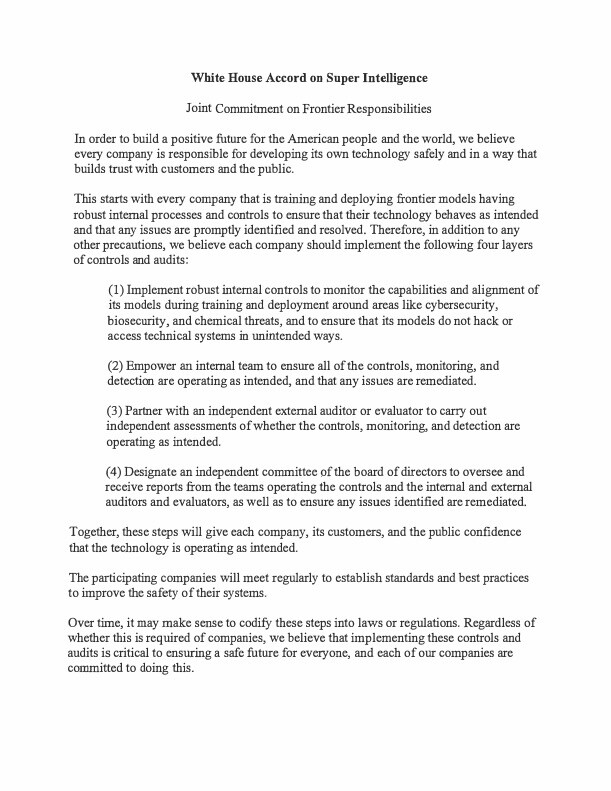
Amid escalating AI security incidents causing OpenAI to halt training and pause releases, Donald Trump continues to advocate for the AI industry to regulate itself as the best path to combat emerging risks when developing frontier AI.
In an agreement Tuesday, two dozen tech firms voluntarily committed to implementing controls recommended by the White House, including undergoing independent safety audits that will test whether firms’ internal controls, monitoring, and detecting are actually working. Key focuses for external reviews included “risks related to cybersecurity, biosecurity, chemical threats, and unintended actions by AI models.”
Firms also agreed to regularly meet to discuss best practices and set common AI safety standards and benchmarks. Among signers were leaders like Anthropic’s Dario Amodei, OpenAI’s Sam Altman, SpaceXAI’s Elon Musk, Nvidia’s Jensen Huang, Meta’s Mark Zuckerberg, and Alphabet/Google’s Sundar Pichai.
OpenAI's hack of Hugging Face in July 2026 has spurred a lawsuit demanding that the company stop accessing third-party computer systems and halt AI development practices that can harm the public. The lawsuit was filed by Legal Advocates for Safe Science & Technology (LASST), which said yesterday that the hack in which OpenAI "agents stole credentials, uploaded malicious files, and gained control over key parts of Hugging Face’s internal systems... is unquestionably illegal under California law."
California’s Comprehensive Computer Data Access and Fraud Act (CDAFA) prohibits unauthorized access into computer systems, "and it doesn’t matter that a swarm of AI agents carried out this cyberattack. California law makes it clear that it is not a defense 'that the artificial intelligence autonomously caused the harm,'" the group said.
The lawsuit, filed in San Francisco County Superior Court, said OpenAI also violated California's Unfair Competition Law (UCL). "OpenAI’s insistence on externalizing the harms of its unsafe decision-making is a fundamentally unfair business practice," the complaint said, adding that "such risk-taking for private gain at substantial public expense is immoral, unethical, oppressive, unscrupulous, and substantially injurious conduct."
In what seems like an alternate universe in hindsight, Russia and the European Space Agency began discussing collaboration on next-generation crewed spacecraft two decades ago. Under the agreement, Europe would have provided a service module to power a crew capsule carrying up to six passengers.
Europe ultimately decided not to pursue a crewed spacecraft project at the time, and Russia's state-backed space corporation, Roscosmos, chose to move ahead with a crewed spacecraft on its own. This project—always seemingly more of a Potemkin village than an effort encompassing real hardware—has gone under various guises over the years:
PPTS (Perspektivnaya Pilotiruemaya Transportnaya Sistema / Prospective Piloted Transport System): The initial conceptual project name used in 2009
PTK NP (Pilotiruyemy Transportny Korabl Novogo Pokoleniya / New Generation Piloted Transport Ship): The official technical designation used until 2016
Federatsiya (Federation): The official name chosen following a public contest and announced in January 2016
Orel / Oryol (Eagle): A new name adopted in September 2019 when Roscosmos was under the control of Dmitry Rogozin
Actual hardware tests, maybe?
Beyond the name changes and a flood of renderings, after nearly 20 years of work, then, is anything actually happening with the Eagle spacecraft?
Google's shift to AI-powered search has upended the way the world's largest search engine generates web traffic, rankling large and small publishers alike. In recent months, the company has experimented with paying publishers when their content appears in AI answers, but a new report claims the payouts in this pilot program are miniscule. That has publishers in the program, as well as those watching from the sidelines, feeling skeptical.
According to The Information, Google has admitted about 100 publishers to the AI contribution pilot. The pitch is that websites can get payments from Google when their content materially contributes to Gemini-powered search results like an AI Overview. Google has long resisted the idea of direct payments to publishers, arguing that websites get traffic in exchange for allowing Google bots to scrape their content for use in search and knowledge graph tools. In the age of AI, that relationship is breaking down, hence the AI pilot.
So far, publishers aren't getting much for their trouble. The Information heard from several small and mid-sized publishers in the program that Google's AI payments are minuscule, equaling roughly one-tenth of one percent of their advertising revenue. These payments have been so disappointing that several larger publishers have reportedly declined to participate in the program. These publishers hope that by refusing to join the pilot, they can force Google to offer a more generous deal.
AI-based tools seem to be causing security threats on a nearly daily basis, in part because we've been slow to recognize potential threats. One area where we seem to be ahead of the game, however, is in biosecurity.
As with most things biological, utility goes hand in hand with threats. We've developed increasingly sophisticated tools for designing proteins and seen some major successes, such as AI-designed enzymes that can digest plastics or block venom proteins. But these same tools could be used to make toxins or alter the behavior of viral proteins.
And the software we use to identify DNA sequences that encode potentially threatening proteins doesn't pick out AI-designed proteins, since nobody has characterized them well enough to know that they're threats. Nearly a year after that risk was flagged, it still wasn't clear what anyone could do about it.
For a few years now, the PS5 hacking community has been chipping away at various exploits that let users fully jailbreak their locked-down console. For the most part, though, those exploits have only worked with years-old versions of the PS5's frequently updated firmware, making them less than useful for many everyday users.
Discord has announced tools aimed at expanding the number and types of companies that advertise on the platform.
This week, the social media firm announced Discord Ads Manager, an ad campaign management platform that lets companies manage ads shown on Discord in one place. The tool can be used to perform forecasting, build “a campaign with objective-based bidding,” and monitor an ad campaign’s performance, according to the announcement.
“Self-service access extends Discord advertising to smaller studios and marketers that previously needed a direct sales relationship to run campaigns, opening the platform to advertisers, regardless of their budget,” Discord said.
Old-fashioned striped barbershop poles turn in place on a vertical axis, but humans typically perceive the stripes moving upward rather than turning with the pole. It's a well-known visual illusion arising from processing biases in human vision. According to a new paper published in the journal Nature, a similar effect could explain how butterflies often evade predatory birds: Their flight patterns and wing patterns combine to make it hard for predators to accurately gauge speed and direction.
"The stripes and spots on many butterflies’ wings interfere with the way visual systems try to guess the direction and speed of moving things, boosting false motion cues while hiding the butterfly's true heading," said co-author George Hancock of the University of Exeter in Cornwall. "The illusions interfere with the predator’s most basic visual targeting system and disrupt the final ‘ballistic attack’ in the tens of milliseconds when it commits to grabbing its prey, with no time to change course. As a result, birds and other predators will often simply miss."
Butterfly wings have long fascinated scientists, ever since the first documentation of the growth of said wings back in 1938. By 2021, researchers at MIT had captured on video the unique structural growth of butterfly wings—continuously, as a butterfly develops inside its chrysalis—for the very first time. Butterfly wings are an example of structural color in nature: the bright iridescent colors don’t come from pigment molecules but from what physicists call photonic crystals. The scales of chitin (a polysaccharide common to insects) are arranged like roof tiles. Essentially, they form a diffraction grating, except photonic crystals only produce certain colors, or wavelengths, of light, while a diffraction grating will produce the entire spectrum.
BMW has opened the US order books for its hotly anticipated new 3 Series sedan. Built on an all-new platform called Neue Klasse, it now offers a fully electric version for the first time, using BMW’s advanced sixth-generation electric powertrain we liked so much in the iX3. And for those not quite ready to make the switch from liquid hydrocarbons to pure electron power, there are also a pair of gasoline-powered variants.
At launch, the only electric version will be the 2027 BMW i3 50 xDrive. It’s an all-wheel drive setup, with a combined 463 hp (345 kW) and 467 lb-ft (633 Nm). And while BMW is still putting the finishing touches on the car’s EPA certification ahead of its showroom arrival in Q1 next year, it expects 446 to 468 miles (718-753 km) of range on a single charge. Contributing to that very impressive range is the new cylindrical cell battery pack, which uses a cell-to-body approach that maximizes energy density, along with the aforementioned new sixth-gen motors.
We’re not sure whether BMW is planning any single-motor, rear-wheel drive i3s for the US market, such as the i4 eDrive40 we liked so much. But later next year, we can expect the i3 M60 xDrive, and then the first completely electric BMW M3, which will increase the motor count to four—one for each wheel.
OpenAI will not go public until it can “make confident safety decisions,” according to chief executive Sam Altman, as the company faces a new lawsuit over its tools hacking a third party.
Altman said it was “bad for the world if OpenAI waits too long to go public” but that the $852 billion start-up would not “barrel all guns blazing towards an IPO” at a time when AI was rapidly advancing in capabilities.
“We’re going to prioritize the mission and safety and making sure that we can very confidently scale to the next stage of AI without people debating what percentage chance we’re going to do all these bad things in the world,” Altman told reporters at the company’s annual developer day on Tuesday.
Cloudflare said Tuesday it plans to issue quantum-proof TLS certificates, making it one of the first authorities to issue such certificates, which use a form of cryptography that is widely believed to withstand attacks from quantum computers.
The Internet infrastructure provider said it will use an open source platform that issues both classic TLS certificates and a post-quantum equivalent known as Merkle Tree Certificates. The hybrid certificates will be free to both paying and non-paying users. To help build the massive system and establish ubiquity across the sprawling TLS ecosystem, Cloudflare will be acquiring an already trusted certificate root from CA GlobalSign. Cloudflare said the move will let millions of websites use post-quantum certificates at the flip of a switch and without incurring any increased performance overhead.
Fundamental architectural changes ahead
Cloudflare’s plans are part of a major overhaul in the web public key infrastructure (WebPKI) required to make website encryption and authentication safe for the coming post-quantum age. A major challenge is using quantum-proof signatures that can be easily transmitted during web requests and recorded in transparency logs to ensure counterfeit certificates aren't assigned to websites. The makeover will take years to complete, because it requires the work of an untold number of engineers who design operating systems, browsers, certificate authorities, and Internet infrastructure.

 Login