❌

Reading view

Rocket Report: FAA eyes more Starbase traffic; India's Skyroot snares US customer

Welcome to Edition 9.15 of the Rocket Report! The launch I'm most looking forward to in the next few weeks is that of Japan's Martian Moons Exploration (MMX) mission. MMX is one of the marquee space science missions launching this year, and it's set to leave Earth as soon as Monday (US time) aboard a Japanese H3 rocket. The spacecraft will visit Phobos and Deimos, the two asteroid-like moons of Mars, deploying a rover and collecting specimens for return to Earth in 2031. Exploration at its finest.

As always, we welcome reader submissions, and if you don't want to miss an issue, please subscribe using the box below (the form will not appear on AMP-enabled versions of the site). Each report will include information on small-, medium-, and heavy-lift rockets as well as a quick look ahead at the next three launches on the calendar.

Reflect Orbital looks to India for launch capacity. California-based Reflect Orbital, the startup attempting to offer sunlight on-demand with in-space mirrors, announced the purchase of two launches Wednesday from Indian launcher Skyroot Aerospace, Payload Space reports. One of the launches will use Skyroot's Vikram-1 rocket, which became the first privately developed Indian rocket to reach orbit in July. The other will fly on an upgraded rocket called the Vikram-1U.

Read full article

Comments

Β© Stoke Space

  •  

Rocket Report: A rare Falcon 9 scrub; is it just about Vulcan's time to shine?

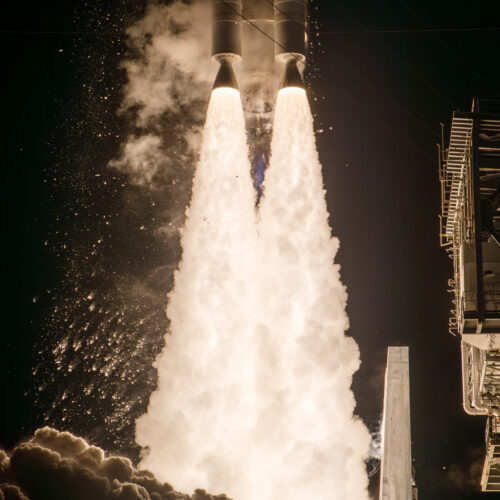
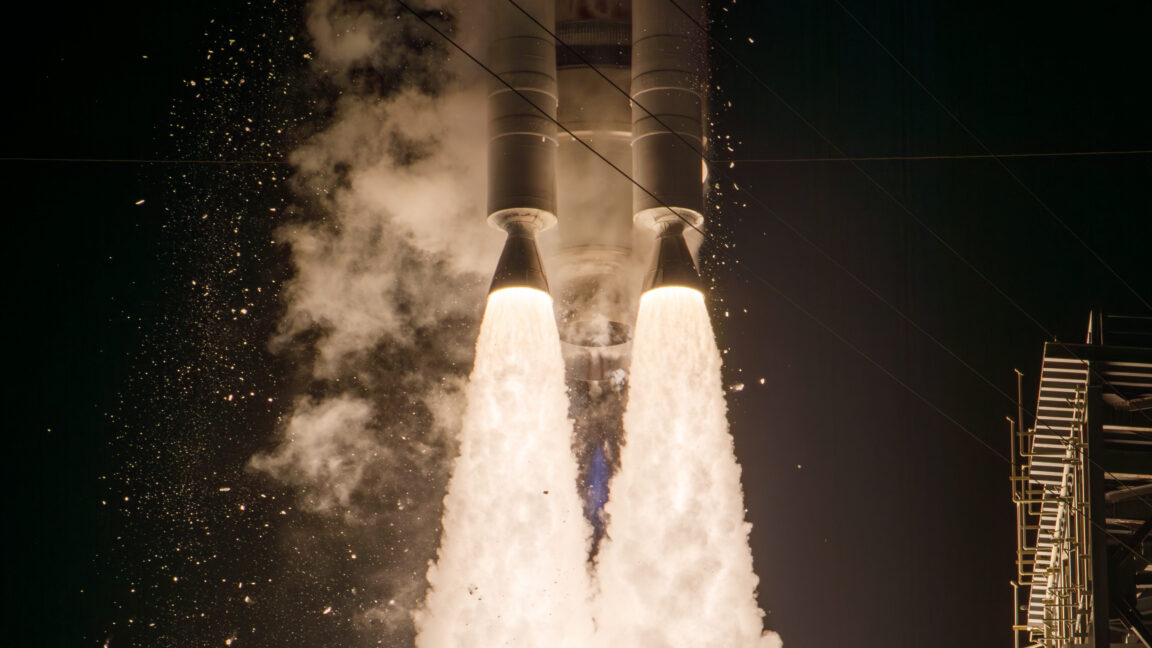
Welcome to Edition 9.14 of the Rocket Report! The big news this week, from our perspective, is that United Launch Alliance's Vulcan rocket appears to be close to launching. We've seen a no-earlier-than launch date for the return to flight mission of October 29 (an Amazon Leo flight), and the next rocket up after that, also an Amazon Leo mission, is also planned for this year. Assuming the solid rocket boosters work, Vulcan could be poised for a major breakthrough next year in cadence.

As always, we welcome reader submissions, and if you don't want to miss an issue, please subscribe using the box below (the form will not appear on AMP-enabled versions of the site). Each report will include information on small-, medium-, and heavy-lift rockets as well as a quick look ahead at the next three launches on the calendar.

Nuri rocket notches another success. South Korea successfully deployed five satellites for its first domestically launched microsatellite constellation during the fifth flight of its homegrown Nuri rocket Wednesday, Yonhap News Agency reports. In addition to the primary payload of five New-space Earth Observation Satellite Constellation for National Safety microsatellites, nine of the rocket's 10 CubeSat secondary payloads were released as planned, according to the Korea AeroSpace Administration. PERSAT-02, developed by South Korean startup Quaternion, failed to separate from the rocket.

Read full article

Comments

Β© United Launch Alliance

  •  

Someone got Doom in an SQL database

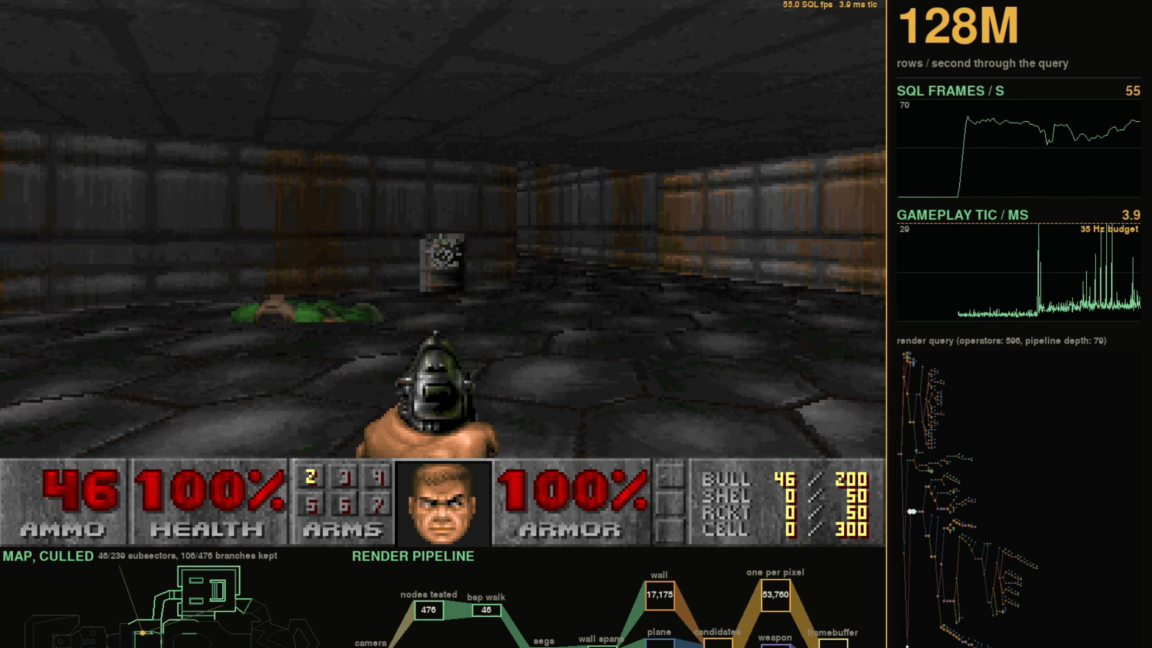
"Rendering Doom in a database is obviously a bad idea," Lukas Vogel writes in a lengthy blog post explaining how exactly he managed to render Doom using an SQL database.

OK, that's not entirely accurate. The SQLDoom project uses a small Python client to handle input and output, drive the game's timing, and display each frame to the screen. Behind that, a series of CedarDB tables tracks the game geometry and state, while about 1,300 lines of SQL queries spread across 89 common table expressions implement the game logic and generate 35 bitmap framebuffers per second.

In this, SQLDoom is a major improvement over Vogel's previous DoomQL project, which last year set out to build "a multiplayer Doom-like shooter entirely in SQL." Unfortunately, that effort ended up with raycasting-based, grayscale ASCII graphics that were more akin to the simplistic 90-degree-angled maps of Wolfenstein 3D. The newer SQLDoom, on the other hand, generates full-color 640x480 frames that look like they could have come from the original Doom executable.

Read full article

Comments

Β© Lukas Vogel

  •  

Rocket Report: SpaceX completes launch triple-header; Rocket Lab nets big contract

Welcome to Edition 9.13 of the Rocket Report!

This week, SpaceX celebrated the first orbital launch of its new Starship rocket. I'm not sure many people, at least those outside of SpaceX, expected it to take 14 flights of Starship before it technically reached low-Earth orbit, but Monday morning's launch finally added that to SpaceX's list of accomplishments with its new super-heavy rocket. Starship had gone 99 percent of the way to orbit before, only held back by safety concerns around the possibility of stranding the huge rocket in space.

What was most notable for SpaceX with this Starship flight was that it unlocked a massive growth potential for Starlink, with the first 26 of the network's new-generation Starlink V3 satellites successfully deployed Monday.

Read full article

Comments

Β© SpaceX

  •  
❌