 Login
Login
New virus catalog reveals which pathogens pose the greatest threat
In a typical year, scientists discover two or three viruses that have never been seen in people before. The number fluctuates, but the trend has been fairly steady since the 1960s.
Most of these viruses attract little attention, and my colleagues and I have often had to search through old medical papers to find any mention of them. Some viruses disappear entirely and are all but forgotten. At the other extreme, the discovery of HIV-1 in 1983 and Sars-CoV-2 in 2020 presaged the AIDS and COVID pandemics, respectively. Both have killed tens of millions.
The next time a scientist finds an unusual or unknown virus in a patient—probably in the next few months—how will they know whether it could lead to a public health emergency on the same scale as AIDS or COVID? My team at the University of Edinburgh has been using the lessons of virus history to help answer this question.
Pandemics come in many forms, but in recent times the biggest culprits have been viruses with genomes made from RNA (rather than the more familiar DNA). Thousands of RNA virus species have been identified, and there may be millions, but only 239 infect humans. We recently published a catalog that helps pinpoint the riskiest ones.
The type and severity of disease are important indicators, but there will be no pandemic unless the virus can spread between people. That could involve physical contact, or inhaling airborne particles, or exposure to blood or feces, or the bite of a mosquito or tick.
For two-thirds of the viruses on our list, an infected person is highly unlikely to pass their infection on. These are known as zoonotic viruses, meaning people usually catch them from animals rather than other people. Rabies is one example.
That sounds reassuring, but viruses evolve quickly and there is an understandable concern that a zoonotic virus might acquire the ability to spread among humans. That’s why scientists are so worried about bird flu. But there is no documented example of an RNA virus doing that. Rabies hasn’t, even though there are tens of thousands of human cases every year.
A much greater threat comes from viruses that already have the ability to spread from person to person. They might become even more transmissible—as did a series of SARS-CoV-2 variants—but they crossed over from animals already able to spread among people. In the distant past, that was the likely origin of measles, mumps, and rubella, along with dozens of viruses associated with colds and gastrointestinal infections.
Then there are viruses that are capable of spreading among humans but, so far, have caused only limited outbreaks. That’s because their R number (how many people, on average, one infected person goes on to infect) is too low and chains of infection eventually die out of their own accord. But R numbers can change; for example, when a virus previously confined to remote villages reaches a city. That happened with Zaire ebolavirus in west Africa in 2014.
There have only ever been a few dozen names on our list of outbreak viruses, but it’s a powerful predictor of public health emergencies. Zaire ebolavirus, the insect-borne Chikungunya, Zika and Oropouche viruses, and mpox (a DNA virus) were original entrants, and all have gone on to cause major epidemics.
Some rarer viruses on our list have become more familiar, too. One is Andes hantavirus, responsible for a recent outbreak on a cruise ship. Another is the Bundibugyo ebolavirus, which is currently spreading in central Africa.
The next pandemic virus
Our data can also help predict what a future pandemic virus—sometimes called disease X—might look like. COVID is a good illustration.
In 2019, my team showed that highly transmissible viruses tend to be closely related to other viruses that spread between humans, but they emerge separately from animals. That turned out to be a perfect description of SARS-CoV-2, very similar to the original SARS coronavirus but independently (and perhaps indirectly) acquired from bats.
The year before, the World Health Organization had proposed a SARS-like coronavirus as a candidate for disease X. That’s why scientists were alarmed about COVID from the outset—it was exactly what they had been looking for.
By contrast, neither Andes nor Bundibugyo virus have the right profile to start a global pandemic. But if it were, for example, a novel virus related to measles then it would be a different story. In that scenario, there would be a real possibility of a worldwide emergency much worse than COVID.
Andes and Bundibugyo do reinforce one important lesson, though: Both had been spreading for weeks before they were picked up. So had COVID. Finding and understanding new viruses faster would deny the next pandemic the same head start, and could make a huge difference to the eventual toll on lives and livelihoods.
Mark Woolhouse is a professor of infectious disease epidemiology at the University of Edinburgh. This article is republished from The Conversation under a Creative Commons license. Read the original article.
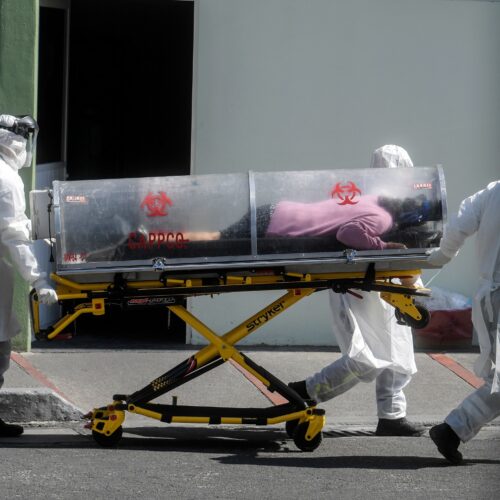

© PEDRO PARDO/AFP