Reading view

A Jupiter-size planet that escaped its star's death

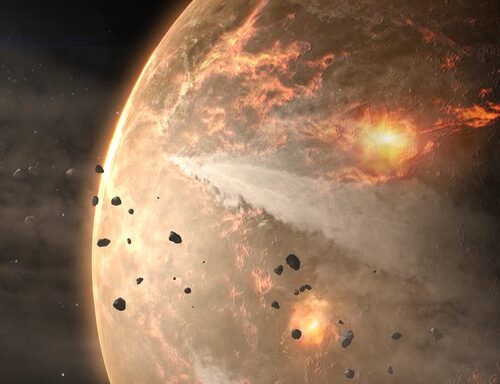
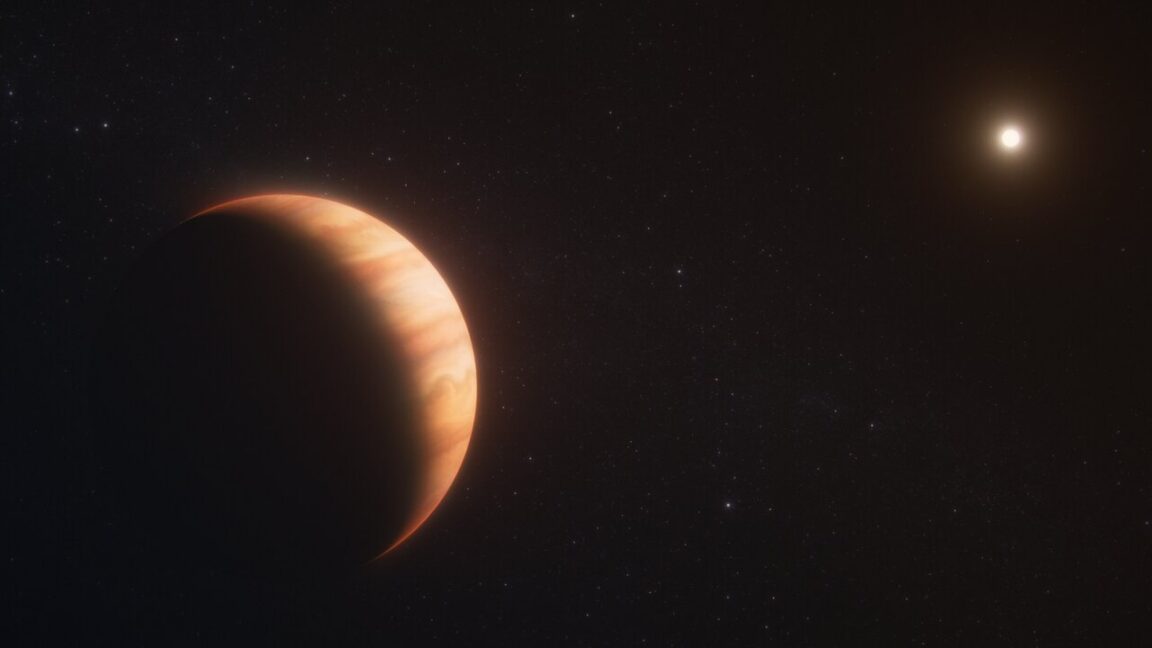
WD 1856 b is the only confirmed case of a planet that survived the death of a Sun-like star. It’s a Jupiter-size world orbiting a white dwarf—the burned-out remnant of a Sun-like star. Now, a team of astronomers has used the James Webb Space Telescope to take a closer look at this planet for the first time, and what they found makes an already strange system even stranger.

A feeding frenzy

WD 1856 b was an accidental discovery. Astronomers pointed the TESS observatory at a sample of roughly 2,000 white dwarfs in 2020. These stars are the remains of a Sun-like star that have already gone through a red-giant phase, leaving behind an Earth-size body that’s primarily composed of elements like carbon and oxygen. The TESS team was searching for small objects like comets or asteroids that might transit across the face of these dead stars.

What they found in the WD 1856 system was a gas giant. “As soon as they looked at it, they said, okay, that’s weird,” said Christopher O’Connor, a theoretical astrophysicist at Cornell University and co-author of the recent Nature study on WD 1856 b.
Read full article

Comments

© NASA, ESA, CSA, R. Crawford

  •  

The missing 500 million: Cosmic bombardment melted Earth's first crust

Earth is the only planet we know of with buoyant, silica-rich continents. But, despite decades of research, geologists still don't agree on how they formed. "The continents started appearing around about four billion years ago—that's the oldest continental rock we know about,” said Tim Johnson, a geologist at Curtin University in Perth, Australia. “The Earth is four and a half billion years old, so why they started appearing then is unknown, as is the mechanism to make that continental crust."

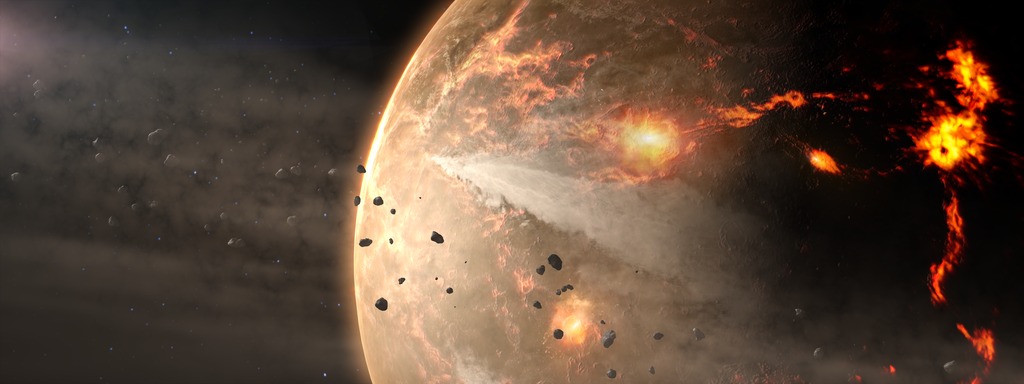
Johnson and his colleagues are now arguing that the formation of continents on Earth was caused largely by an intense, sustained barrage of asteroid impacts that kept the early crust hot and thin enough to make buoyant continents possible. In short, the lands we live on are here because of ancient bombardment from space.

Plates and plumes

The problem with studying the formation of continents is that the geological evidence of this process is almost gone. The oldest known continental-type rocks crystallized around 4.03 billion years ago, right at the end of the Hadean eon (the earliest era in Earth’s history, spanning the first 500 million years of its existence). Rare basaltic rocks date back about 4.2 billion years, and a handful of the oldest zircon crystals push the record back to 4.4 billion years. Beyond that, there's hardly anything else. So, scientists looking into the origin of continents had to rely largely on educated guesses. “There are huge debates about what was going on in the early Earth, because the data is so scarce,” Johnson said.

Read full article

Comments

© NASA's Goddard Space Flight Center Conceptual Image Lab

  •  

Visiting the stars (and planets, and telescopes) in VR

Having a computer strapped to my face for 40 minutes was one reason to feel a little sweaty. But the tour of the Universe I had just received in virtual reality—including visits to the near vicinity of the Sun, the giant black hole at the center of our galaxy, and a hellscape of an exoplanet 41 light-years distant—provided another excuse for sensing some heat.

Smithsonian Starstruck: An Immersive Experience is a 40-minute astronomy walk-through. It debuted in Washington, DC, in May with solo adult tickets now ranging from $29 to $35 and group tickets for four or more starting at $18 each (all now discounted by 15 percent); it will also open in Denver, Orlando, Florida, and San Antonio, Texas, later this year. I stopped by on a Monday in June to take it in.

After some onboarding that included setting such preferences as closed captioning and signing a waiver, I had enough time to sit on a bench next to the exhibit space (which has hosted other VR experiences) to enjoy watching another attendee with a VR headset blurt out, “Oh my God!”

Read full article

Comments

© Smithsonian Starstruck

  •  
❌