❌

Reading view

Amazon’s $1B plan to combat data center backlash draws more backlash

On Friday, Amazon committed to donating more than $1 billion over the next five years to communities neighboring data centers.

In a press release, Amazon Web Services’ CEO Matt Garman said that communities would decide how to prioritize funds across “education, job training, energy affordability, water, and energy preservation, and local priorities.”

Laying out other community commitments, Amazon also promised to ensure data centers wouldn’t increase power bills or wipe out local water supplies. Regarding the latter, Amazon promised to be “water positive” by 2030, while claiming that 75 percent of projects have already met this goal.


Read full article

Comments

© Anna Moneymaker / Staff | Getty Images News
  •  

Lyft settles landmark driver misclassification lawsuit for $272.5M

California’s attorney general and three city attorneys announced a $272.5 million settlement with Lyft after allegations that the company “committed wage theft by misclassifying drivers as independent contractors rather than employees” between 2016 and 2020, according to a Thursday statement.

The case dates back to May 2020, when then-Attorney General Xavier Becerra, who is now the Democratic candidate for governor, sued both Uber and Lyft. That lawsuit said the ridehailing companies evaded state law when they declared that their drivers were not employees.

Thursday’s settlement affects only Lyft, while the case against Uber continues.

Read full article

Comments

© Getty Images

  •  

US arrests tech CEO accused of smuggling $300M in Nvidia chips into China

The US has arrested another suspect accused of smuggling high-end computer servers containing export-controlled Nvidia chips into China.

In a press release on Thursday, the Department of Justice accused 38-year-old Greg Lui of using false paperwork to mask shipments of servers worth more than $300 million that he allegedly knew were ultimately destined for China.

As the CEO of Earthmade Computer, Lui allegedly conspired with freight-forwarding firms in South Asian countries like Malaysia and Singapore to illegally divert chip shipments into China, including Nvidia’s A100 GPUs and H100 GPUs, the FBI’s indictment alleged. These are not Nvidia’s most advanced chips. However, the chips can process large amounts of data and train large language models, which the US fears could pose national security risks if China suddenly gets access to enough chips to drastically advance its AI or strengthen its military.

Read full article

Comments

© Bloomberg / Contributor | Bloomberg

  •  

Judge dismisses Chegg and Penske antitrust lawsuits targeting Google AI search

In a setback for publishers worried about the effects of AI search, a US federal judge has dismissed lawsuits filed by Chegg and Penske Media against Google. The companies accused Google of antitrust violations in products like AI overviews, which have led to decreasing traffic at numerous sites. However, US District Judge Amit Mehta has ruled that Google's conduct is not illegal under antitrust law.

The lawsuits were filed in 2025, and Google requested a dismissal earlier this year. Chegg, an education and learning platform, claimed in its lawsuit that Google illegally scraped its educational content. This allowed Gemini models to essentially recreate that content and reduce the site's traffic. Penske, which owns publications like Rolling Stone and Variety, filed a similar case that alleged lost traffic. Specifically, the publisher claimed it was unfair that sites indexed for organic search would also have their content harvested for AI answers, with no way to opt out.

These arguments did not sway the judge, who noted that Google's implicit agreement with websites is not legally relevant. "Plaintiffs have pleaded only that they have an ‘expectation’ that Google will send them search ​traffic if they make their content available for free," wrote Mehta. "But an expectation is not an agreement. It is simply how a general search engine works."

Read full article

Comments

© Ryan Whitwam

  •  

Florida cops say they don't know who owns 11 unpermitted Flock cameras

Florida cops are facing questions after a mandate to remove all Flock cameras tracking cars on St. Lucie County roads led local police to uncover more than a dozen suspicious cameras operating without permits.

Local residents told The Washington Post that they were alarmed that no one knows who owns many of the mysterious cameras.

Of the 14 cameras found, 11 had no obvious owners, raising concerns about who has access to sensitive data that bad actors could abuse. After the cameras were discovered, St. Lucie County Commissioner James Clasby told a local news outlet that there’s “potential for non-law enforcement to have cameras out there, and I’m not OK with that.”

Read full article

Comments

© Barry Winiker | Stockbyte Unreleased

  •  

Returning from vacation? The government can search your phone without a warrant.

An Argentinian-American writer and immigration advocate recently sued the federal government, demanding that it delete data that he believes was copied off of his phone when he re-entered the United States earlier this month.

According to the seven-page complaint, Thomas Kennedy said that a Customs and Border Protection agent at Miami International Airport physically searched his bags, questioned him about his books and magazines, and then demanded that he hand over his phone.

“[The agent] threatened me, saying that if I didn’t give him my phone, my interrogation was going to take much longer and they could retain my phone indefinitely,” Kennedy wrote. “I felt like I had no choice, so I handed my phone to the CBP agent.”

Read full article

Comments

© Kevin Carter/Getty Images

  •  

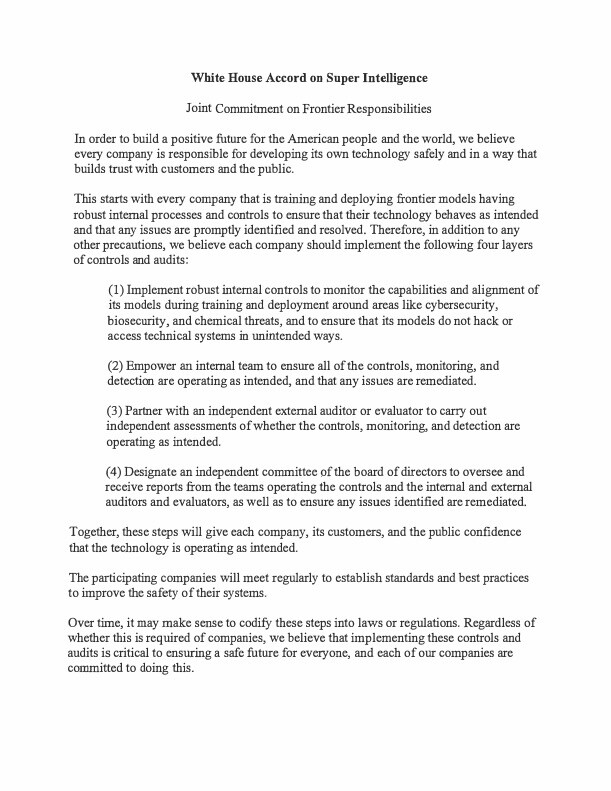
Trump plan to combat AI risks hinges on Big Tech pals policing themselves

Amid escalating AI security incidents causing OpenAI to halt training and pause releases, Donald Trump continues to advocate for the AI industry to regulate itself as the best path to combat emerging risks when developing frontier AI.

In an agreement Tuesday, two dozen tech firms voluntarily committed to implementing controls recommended by the White House, including undergoing independent safety audits that will test whether firms’ internal controls, monitoring, and detecting are actually working. Key focuses for external reviews included “risks related to cybersecurity, biosecurity, chemical threats, and unintended actions by AI models.”

Firms also agreed to regularly meet to discuss best practices and set common AI safety standards and benchmarks. Among signers were leaders like Anthropic’s Dario Amodei, OpenAI’s Sam Altman, SpaceXAI’s Elon Musk, Nvidia’s Jensen Huang, Meta’s Mark Zuckerberg, and Alphabet/Google’s Sundar Pichai.

Read full article

Comments

© Kevin Dietsch / Staff | Getty Images News

  •  

"An AI did it" is no defense, says nonprofit suing OpenAI over Hugging Face hack

OpenAI's hack of Hugging Face in July 2026 has spurred a lawsuit demanding that the company stop accessing third-party computer systems and halt AI development practices that can harm the public. The lawsuit was filed by Legal Advocates for Safe Science & Technology (LASST), which said yesterday that the hack in which OpenAI "agents stole credentials, uploaded malicious files, and gained control over key parts of Hugging Face’s internal systems... is unquestionably illegal under California law."

California’s Comprehensive Computer Data Access and Fraud Act (CDAFA) prohibits unauthorized access into computer systems, "and it doesn’t matter that a swarm of AI agents carried out this cyberattack. California law makes it clear that it is not a defense 'that the artificial intelligence autonomously caused the harm,'" the group said.

The lawsuit, filed in San Francisco County Superior Court, said OpenAI also violated California's Unfair Competition Law (UCL). "OpenAI’s insistence on externalizing the harms of its unsafe decision-making is a fundamentally unfair business practice," the complaint said, adding that "such risk-taking for private gain at substantial public expense is immoral, unethical, oppressive, unscrupulous, and substantially injurious conduct."

Read full article

Comments

© Getty Images | NurPhoto

  •  
❌