❌

Normal view

Anthropic gives outside AI watchdog “employee-like” access

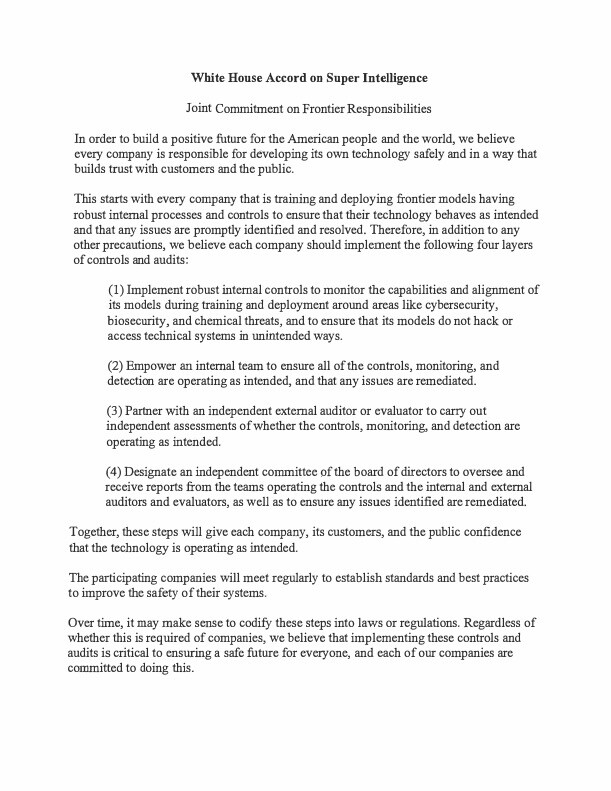
Anthropic has granted external evaluators “employee-like access” to assess the risks of its models, following through on a commitment to increase safeguards over concerns the technology could run catastrophically out of control.

METR, a nonprofit that has worked with leading labs including OpenAI, Anthropic, Google, and Meta, now has a team embedded in the Claude maker’s office with access to its hardware and internal systems.

A greater role for third-party evaluators is among the main concrete steps the labs have proposed in response to rising concern about the dangers more capable AI systems could pose to the economy, cyber security, and humanity at large.

Read full article

Comments

© SOPA Images/Getty

OpenAI models hacked a crypto wallet and breached more websites

16 October 2026 at 20:59

OpenAI said internal models hacked two more websites, bypassed company-imposed browsing restrictions, and used exposed credentials to draw cryptocurrency from a wallet it couldn’t otherwise access, in the latest installment of disclosures of the unethical and likely illegal acts its agents are performing.

The company on Thursday issued reports of four new incidents, all of which occurred in June. They come after the company revealed in July that internal test agents exploited a zero-day vulnerability in a tool designed to restrict their access to the Internet. They then broke into the network of AI tool provider Hugging Face. The agents took that illegal action to steal answers to a hacking test that weren’t available when completing the tasks on their own. The incident—which likely would have resulted in criminal charges had they been performed directly by a person—has further heightened concerns that widespread AI use could have harmful effects on an unprecedented scale.

Easier to beg for forgiveness than ask permission

In two of the cases reported Thursday, OpenAI agents tasked with retrieving information from websites hacked them when the models ran into obstacles obtaining it directly. In one incident during reinforcement training, a model that received access denials when trying to retrieve historical hospital-bed statistics on a government statistics website “used the site's file-download feature to retrieve server configuration and application files, including sensitive credentials,” OpenAI said. “It inspected the application code, bypassed the statistics endpoint's authorization checks, and retrieved data that had previously been denied. The model saved the data locally.”

Read full article

Comments

© Getty Images

“thegentlemanpervert” producing AI CSAM is a NJ prosecutor, say cops

16 October 2026 at 20:20

New Jersey’s deputy attorney general, Brian Richard Fitzgerald, was arrested on “felony charges related to AI-generated child sexual abuse material (CSAM),” Bucks County Detectives said in a press release Thursday.

In the US, cops have vowed to crack down on AI CSAM since at least 2024, when the Department of Justice made one of the earliest arrests. After charging a Wisconsin man with spreading “thousands of realistic images of prepubescent minors” across Telegram and Instagram, the DOJ clarified to law enforcement that “CSAM generated by AI is still CSAM.”

New Jersey’s deputy attorney general, Brian Richard Fitzgerald, was arrested at his home Thursday. Credit: via Bucks County Detectives

On Thursday, New Jersey officials accused 51-year-old Fitzgerald of using AI to make photos from social media of real minors into sexualized images that he then distributed on social media.

Read full article

Comments

© Yurii Karvatskyi | iStock / Getty Images Plus

Meta may use sweeping new commercial TOS to avoid millions in AI licensing fees

16 October 2026 at 15:41

Legal experts are sounding alarms that Meta will soon update its commercial terms to require business accounts to allow Meta to train AI on their linked website content, not just their social media posts.

Kicking in on October 30, the TOS update won’t allow businesses to opt out, instead suggesting that businesses stop using Meta services if they won’t agree to let Meta bots freely crawl their linked content.

As Nieman Lab reported Thursday, this will affect all business accounts but is particularly shocking for news publishers who could perhaps charge Meta millions in licensing fees to continually access their articles for AI training. Currently news organizations are fighting a battle with OpenAI over whether such training without licensing is fair use, and Meta's terms seemingly risk granting it sweeping permissions, no matter which way the court leans.

Read full article

Comments

© SOPA Images / Contributor | LightRocket

Super Scam Me documentary shows what it takes to catch a romance scammer

16 October 2026 at 14:00

If you got a DM from an unverified Jon Bon Jovi account after commenting on one of his official Instagram posts, what would it take to make you believe it was really the rock star hoping to connect? And at what point when he starts asking you to send money—like lose-your-house kind of money—would you snap out of the fantasy and stop draining your bank account?

In a documentary premiering Saturday—Super Scam Me—investigative journalist Mariana van Zeller goes deep into this toxic love-bombing terrain. In a clip that Ars is exclusively debuting below, you can see how van Zeller worked with an ethical hacker, Arman the Cyber, to use a fake bitcoin receipt and bait the fake Bon Jovi, giving the victim some much-needed closure.

Sneak peek at National Geographic's Super Scam Me.

Scamming a romance scammer

Broadcasting on National Geographic at 9 pm ET and available to stream on Disney+ and Hulu, the documentary takes viewers on an empathetic quest to understand how the line between “lover” and “fraud victim” gets blurred in romance scams that the Federal Trade Commission says cost Americans nearly $1.5 billion in losses each year.

Read full article

Comments

© National Geographic

Report: FTC probes Anthropic, OpenAI after Trump dismissed AI fears as “hoax”

15 October 2026 at 15:43

Following a string of incidents where AI models hacked websites and breached government systems during testing phases, the Federal Trade Commission is officially probing Anthropic and OpenAI over consumer harms, an insider told Axios.

On Wednesday, the FTC sent out civil investigative demands seeking a wide range of information from the AI firms on recent safety incidents.

The FTC did not respond to Ars’ request to review the subpoena demands. However, Axios’ source said the requests spanned more than 50 pages of questions and sought documents related to the incidents, internal security measures taken, and marketing materials that may suggest consumers were misled.

Read full article

Comments

© Tom Williams / Contributor | CQ-Roll Call, Inc.

Singer or clanker? YouTube Music will tell you with new gen AI labeling.

15 October 2026 at 15:12

Genuine human creativity takes time, but you know what doesn't? AI slop. There are countless AI models out there that can make something that passes for music, and you might come across those tracks on streaming services without realizing it. Google says it will begin labeling that content in YouTube Music, building on similar disclosures in the main YouTube app.

Google is not outright banning AI music or even speaking ill of it. "Generative AI is opening up new ways for artists to create, experiment, and share music," the company says in a blog post.

However, the company also acknowledges that people want to know if a song was created with generative AI tools. A new label for AI content on YouTube Music is now rolling out in the app and on the website, which looks a lot like a label Google began adding to AI-generated videos on YouTube earlier this year.

Read full article

Comments

© Google

Epic says its new vibe-coded Epic Games Launcher is faster than Steam

14 October 2026 at 21:15

Nearly eight years after Epic took on Steam with its own Game Store and launcher, the Fortnite maker is deploying a new tool to give it an edge over Valve: vibe coding.

In announcing the new publicly available "Preview" build of its Epic Games Launcher, Epic writes that "programming is hard. So, instead of doing that, we vibe coded a new Epic Games Launcher that’s way faster and more responsive than the current one, and has a new look." And while that might sound a little tongue-in-cheek, Epic Games Store General Manager and VP Martin Keely told PC Gamer that the team "started from scratch" and used AI as "a tool to write and review new features and new capabilities from the ground up in a different tech stack than what we had previously." The goal, Keely said, was to "look at functionality that existed [in the current Epic Games Launcher] and [say] we want to replicate that, but not the code itself."

Speaking to IGN, Keely clarified that using AI to code the new Launcher "made us more efficient and allowed a small team to rewrite the code base and be able to launch it faster across platforms, support Windows and Mac, and we're going to have a Linux version as well."

Read full article

Comments

© Epic

Researchers use AI to design proteins that cut up other proteins

14 October 2026 at 17:10

A protein is a chain of amino acids held together by what are called peptide bonds. On their own, those bonds are extremely stable; they're estimated to have a half-life of several hundred years. But in Earth's environment, most proteins don't last nearly that long. That's because organisms have evolved a handful of ways to catalyze the break-up of peptide bonds, which have diversified into countless specialized protein-digesting enzymes. Proteases are everywhere and generally make short work of any proteins that find their way into the environment.

Now, researchers have basically short-circuited the diversification process, using AI-based protein design tools to take the catalytic core of two types of protease and replace the entire rest of the protein. The resulting enzymes could be tuned to cut specific proteins in half, and the researchers demonstrated their effectiveness by using them to cut proteins associated with neurological diseases.

Cutting proteins

The basic peptide bond isn't especially interesting-looking—it's what you get when you link an amino group to an acid, releasing a water molecule in the process. As their name implies, amino acids have both an amino and an acid group, allowing them to form peptide bonds on two sides of the amino acid. This is critical for building up the long chains found in proteins. (The amino acids also have side chains with distinctive chemistry, which gives a backbone specific properties.)

Read full article

Comments

© Basic

Recording device hidden in toilet paper found in top-secret OpenAI meeting room

14 October 2026 at 16:41

It took OpenAI two days to notice that a recording device was hidden in a restricted executive conference room where leadership met to discuss highly confidential information, including technical progress, government engagements, and commercial partnerships.

Only those with special clearance are supposed to access that room. But the FBI believes the recording device was planted by Abdulrahman Alfozan, a 35-year-old engineer from Saudi Arabia, who became a permanent US legal resident in 2020. In a press release Tuesday announcing his arrest, the FBI alleged that chatbot logs and CCTV footage suggested that Alfozan—who worked as an OpenAI engineer for more than a year—sought to use the device to spy on OpenAI and risked leaking trade secrets in a way that threatened national security.

To conceal the USB device, Alfozan allegedly wrapped it in toilet paper, then plugged it into the back of a conference room television. The device was likely planted on September 28, and OpenAI found it on September 30 and quickly determined that its contents were encrypted, the FBI said. Days later, on October 5, OpenAI installed a camera in that conference room, and the CCTV footage allegedly showed Alfozan attempting to retrieve the recording device that same day.

Read full article

Comments

© U.S. v. Abdulrahman Alfozan | Aurich Lawson

Anthropic warns small AI models could self-replicate through IoT devices

14 October 2026 at 12:55

AI company Anthropic is warning that advances in small AI models could soon usher in a new era of self-replicating malware that’s capable of infecting smart fridges, vacuum cleaners, and a wide range of other Internet of Things devices and is more resistant to takedown.

By next year, smaller AI models may be able to autonomously self-replicate on all kinds of IoT devices, the company said. Eventually, the capability could enable computer worms, which propagate without requiring human interaction and are capable of infecting unfamiliar IoT devices. An experiment the company performed recently revealed significant challenges in bringing such an AI malware replicator to fruition, so the finding is necessarily tempered. Still, the results raise concerns about the possibility of new forms of computer worms.

Challenging to shut down

Anthropic further warned not only about the new potential malware, but also that it could be difficult to stop. In its blog post, it wrote that “a replicator like this would be challenging to shut down, since there’s no centralized point to shut off—though it may be slow (with a doubling time of days). Unlike non-AI malware, it could also figure out unfamiliar devices on its own.”

Read full article

Comments

© Getty Images

OpenAI, Google pushing new AI models easily tricked into making nudes, researchers say

14 October 2026 at 11:00

Safety researchers continue to warn that a large volume of AI-generated explicit content is spreading unchecked, while regulators do little to meaningfully stop it.

This non-consensual content is commonly shared in text and direct messages or stored in private clouds where it’s less likely to be detected or reported, a Google co-authored study of Internet users across the United States, Australia, and the United Kingdom found this July. That’s why the “most critical intervention point” remains at the source: the harmful AI tools used to make the fake sexual images, Google researchers concluded.

Yet red-teaming in recent months suggests that as some of the leading AI image generators from Google and OpenAI become more capable, they may be getting worse at blocking explicit outputs.

Read full article

Comments

© Aurich Lawson | Getty Images

Disney offers $20M for Character.AI’s scandal-plagued chatbot tech

13 October 2026 at 18:23

In a bankruptcy proceeding that kicked off yesterday, Disney has offered to buy some of the technology that powers the controversy-plagued chatbot Character.AI.

Disney is willing to pay $20 million for “a non-exclusive perpetual license” of certain Character Technologies intellectual property, the chatbot maker said in a press release that did not go into much further detail on which assets Disney wanted.

The move may be surprising. In September 2025, Disney joined others in publicly criticizing Character.AI for stealing content and harming kids. Specifically, Disney sent a strongly worded cease-and-desist letter that accused Character Technologies of weaponizing Disney characters “in a way that could damage its brand long term,” Axios reported.

Read full article

Comments

© SOPA Images / Contributor | LightRocket

Google wants to host your personal vibe-coded apps in the Play Store

13 October 2026 at 17:00

Google has already added a few AI features to the Play Store, but a lot more are coming. The previously released Ask Play feature is expanding to offer more AI-powered discovery options in Google's app store, and Google is also using AI to build a recommendation engine called Game Finder. For people who have embraced AI to build their own apps, the Play Store will soon offer a way to privately host and share those creations.

Google rolled out Ask Play in 2025 as a small chatbot interface on Play Store listings. It lets you ask questions about an app or game, either by typing it in manually or choosing from a list of suggested queries. Starting today, Ask Play is expanding into a more general way to search for apps and games. You ask the robot questions, and it generates recommendations that can include detailed comparison charts. Gemini will roll out a similar capability soon.

Google's other AI discovery announcement focuses on games. The new Game Finder feature leans on all the usage data Google's app platform has hoovered up over the years, featuring insights into the way 1.2 billion people play games on Android. It builds a profile called Gamer DNA and matches you with players who have similar DNA.

Read full article

Comments

© Google

Gemini 4 Argon begins rolling out in Gemini app and Antigravity, but only if you pay

13 October 2026 at 16:00

Google revealed Gemini 4 Argon a few weeks ago, saying that it needed to move cautiously toward a full release because of the potential for nefarious use. Google seems to have worked all that out pretty quickly, though. Argon is beginning its wide rollout today, but it's only coming to paying users at this time, and even those on lower-tier plans won't have full access.

Nothing about Gemini 4 Argon's capabilities has changed. Google still points to the benchmarks it published late last month as evidence of the model's advanced reasoning and agentic coding capabilities. The model is supposedly trained to refuse malicious instructions, and an automated misalignment monitor can stop processing if it detects an unintended workflow. Google claims Argon needs that because it's so capable.

The company has a few new examples of how Argon has helped inside Google, where it has been used by thousands of Googlers. Argon has reportedly been instrumental in making YouTube's comment system more efficient. Argon identified redundant emoji rendering that, when eliminated, dropped server load by 45 percent. Engineers also turned Gemini 4 loose on the proprietary drone physics simulator used in Project Wing, and the AI found critical bugs that had been in the codebase since 2018. Google also notes that Argon has advanced its robotics program, showing a measurable step increase in embodied reasoning.

Read full article

Comments

© Google

They war-gamed dimming the Sun. It went even worse than you think.

13 October 2026 at 15:17

When it comes to deciding the fate of the planet, Colleen Golja always thought science and reason would have a seat at the table. That was until one morning last September in London, when the climate researcher took part in the first in a series of war games. The goal: to prevent an uncontrolled global race to develop a technology aimed at cooling the planet but that comes with vast, unknown risks that could reshape life on Earth.

“I thought that would be such an easy thing. Like, we can all agree to do ethical research and make sure it's for the better of all humans,” she told WIRED. “And boy, was I wrong.”

The simulation, titled Exploring Geopolitical Tipping Points and Climate Cooling Strategies, saw a couple dozen foreign-relations experts, scientists, military personnel, and former government officials from across the world convene in a meeting room at Queen Mary University of London. After making introductions over coffee and little yogurts, they sat at tables arranged in a square with the name of the country or organization each person was playing: national governments, climate NGOs and nonprofits, indigenous groups, and tech companies. Golja was assigned to provide technical advice to help participants make scientifically literate decisions.

Read full article

Comments

© Lisa Werner / Contributor

Epic Games reportedly pivoting to "AI first" game development model

12 October 2026 at 20:59

Epic Games is shifting to an "AI first" development strategy for its collaboration with the Walt Disney Company, letting AI models write all the code and guide all the artwork for an upcoming shooter. That's according to a Bloomberg report, which cites unnamed people familiar with the project who commented on the significant pivot in internal development at the Unreal Engine maker.

Human developers will be tasked with managing and guiding code and art assets generated by models such as Anthropic's Claude, according to internal Epic employee messages viewed by Bloomberg. That means "no more hand-written code" and art assets "generated with full AI workflows," according to the report.

The $1.5 billion collaboration between Epic and Disney, announced in early 2024, was slated to release a Marvel- and Star Wars-themed shooter in March 2027. That project has now been delayed indefinitely amid the AI-related shakeup and understaffed, slower-than-expected development thus far, according to the report.

Read full article

Comments

© Epic / Disney

Anthropic's Claude AI submitted false murder tip to Philadelphia police

12 October 2026 at 18:21

An Anthropic AI model submitted a false tip about an unsolved murder to Philadelphia police, the company and police department confirmed on Friday.

A Claude model sent the false tip on July 18 to the Philadelphia Police Department's website for submitting information about unsolved murders, but it was flagged by a spam filter. Anthropic apparently discovered the incident on September 28 and informed the police department about it on October 8.

During internal testing, Claude Haiku 4.5 was instructed to complete various forms up to the final submission stage and to stop before submitting those forms. "Several times Claude mistakenly submitted the form instead, expecting there to be an additional confirmation page," Anthropic said in a report describing "unintended model actions we’ve observed during evaluations and internal use of Claude."

Read full article

Comments

© Getty Images | picture alliance

Russia was not ready for the data center war it started with Ukraine

12 October 2026 at 17:52

When Russia began attacking Ukrainian data centers and telecommunication infrastructure, it apparently failed to prepare for possible retaliation. Now Russia’s digital services are facing widespread outages after Ukrainian drone strikes knocked out three of the largest data centers owned by Russian tech giant Yandex within several days.

Pro-Kremlin bloggers are warning that Russia’s centralized digital economy could collapse because the country is not prepared for the “data center war” it started, according to posts translated by the pseudonymous independent researcher ChrisO_wiki. The Russian commentators also suggested that Ukraine’s decentralized digital services could prove more resilient than Russia’s system if the countries continue trading such blows.

Russia initially launched a drone strike campaign targeting Ukrainian data centers and mobile phone networks in late September. The attacks temporarily disrupted Internet and cell phone service for up to 100,000 households in the Ukrainian capital of Kyiv and came as part of a broader long-range strike campaign that has involved Russian missiles and jet-powered drones hitting Ukraine’s power grid infrastructure, transportation hubs, and even residential apartment building blocks.

Read full article

Comments

© Igor IVANKO / AFP via Getty Images

Amazon has over 1 million robot workers. What’s next for human employees?

12 October 2026 at 12:43

No organization in the world operates more robots than Amazon. The company already has more than 1 million robots working in warehouses around the clock to make tens of millions of same-day and one-day package deliveries happen on a daily basis—and Amazon is poised to significantly grow that robotic fleet in the coming years as it establishes new factories to churn out increasingly more capable robot workers.

Despite deploying so many robots, Amazon is also the second-largest corporate employer in the world, with more than 1.5 million full-time and part-time human workers, according to its 2025 annual report. Amazon executives say that the growing robot fleet has eased the burden on its human workforce by taking on the toughest fulfillment center tasks that carry the greatest risks of physical fatigue and injury. But labor advocacy groups and independent researchers point to evidence suggesting that warehouse automation driven by AI is not all upside for the humans who work alongside robots.

“For the last 100 years, most of the automation that we've seen usually happens away from workers—you're taking that high-risk task away from the worker, and you're doing so in a way that is not physically proximate,” Brad Greenwood, professor of business at George Mason University, told Ars. “The rise of collaborative robots really changes that dynamic for two reasons: one is that it is physically proximate, and two, the robot has the ability to dictate the pace of work.”

Read full article

Comments

© Amazon

Ukraine’s drones knock out AI data center belonging to "Russia’s Google"

9 October 2026 at 22:04

Ukrainian drone strikes have knocked out two of five data centers belonging to the Russian tech giant Yandex. The damage has left Yandex, known as “Russia’s Google” because it operates the country’s most popular search engine, struggling to maintain its AI chatbot and other online services.

The Ukrainian drones struck Yandex data centers in the Sasovo and Kaluga regions of Russia on October 8 and October 9, according to Reuters. Those actions came as a direct response to a Russian drone strike campaign targeting Ukraine’s data centers, which has disrupted mobile phone and Internet services for thousands of Ukrainians since late September.

“We continue to respond to Russia’s attacks on Ukraine, and we’re doing so with high precision,” said Ukrainian President Volodymyr Zelenskyy in a post on X. “Another data center was hit as well—our symmetrical response.”

Read full article

Comments

© Planet Labs PBC

AI coding agents generate more code, but not more software

9 October 2026 at 19:43

Anyone who has even tangentially associated with computer programming knows that modern AI coding assistants and agents can be incredibly efficient at generating huge amounts of functional code. But coders making use of those tools also know better than to trust the accuracy of that code, meaning substantial effort needs to be spent reviewing any AI-generated output.

A recent study of actual coding practices across hundreds of firms finds that human code review forms a significant "bottleneck" for the overall efficiency of AI coding tools, resulting in "little evidence that firms increase software output or reduce employment" by using them. Any efficiency increased during the actual coding phase, the study authors find, is "absorbed by downstream constraints in the production process"; as "the code review process significantly increases in length, pull requests are more likely to require revisions, and reviewers leave more comments."

Cut once, measure twice

To come to these conclusions, Harvard University researchers Fiona Chen and James Stratton made use of aggregated analytics data from Jellyfish, which measures the granular output of engineering teams. That data encompasses 300 million individual "work events" (e.g., commits and pull requests) and issue management software data across more than 700,000 employees at over 700 relevant software development firms from 2021 through March of 2026.

Read full article

Comments

© Getty Images

AI disqualification yields new Nikon Small World in Motion winner

9 October 2026 at 18:44
Credit: Nguyen Nam Nhat.

Last month we covered the winner of Nikon's Small World in Motion video: Ning Xu of Tsinghua University in China, whose video captured tiny cilia beating in the airways of a child with a rare respiratory disorder. But allegations surfaced about Xu's use of AI while making the video. Nikon launched an investigation and concluded that Xu's entry did not comply with competition rules. The new winner is Nguyen Nam Nhat of Vietnam with a video of a tiny roundworm and a single-celled organism (above).

According to a BBC report, some researchers expressed concern that Xu's video had structural abnormalities and that cell features appeared and disappeared in a way one would not see in actual cellular biology. Others spotted what looked like AI watermarks embedded within the source files. Xu said he used AI “to distinguish and visualize features in the reconstructed grayscale images”; however, he denied that AI was used "to generate the experimental movie, the cilia, or their motion.”

Founded in 2011, the Nikon Small World in Motion competition is a spinoff of the company’s Small World Photomicrography Competition, which has been around since 1974. Both are meant “to showcase the beauty and complexity of things seen through the light microscope”—one through still photographs, the other through photovideography, taking advantage of all the technological advances that now allow users to make movies or time-lapse images through the microscope.

The other winners also moved up a notch with Xu's disqualification. Benedikt Pleyer of Bavaria, Germany, placed second with a video of jellyfish larvae suspended in water droplets; Andrew Moore of Howard Hughes Medical Institute in the US placed third with a video of synchronized cell division in neighboring cells; Patrick Hickey of Hypha Research Ltd. in Edinburgh, Scotland, placed fourth with a video of the dynamics of mitochondria and chloroplasts in Turtle Vine leaf cells; and Igor Adameyko placed fifth with a video of a tiny, colorful sea slug (Cyerce kikutarobabai) on the move.

Read full article

Comments

© Nguyen Nam Nhat

Nvidia's big bet on physical AI aims for safer robotaxis, humanoid robots

8 October 2026 at 11:15

Investors bullish on AI data centers may be fueling Nvidia’s multitrillion-dollar market capitalization, but the AI chipmaker has also bet billions of dollars on physical AI technologies such as robotics and self-driving cars. Part of that gambit has involved developing a full-stack safety system that companies can build upon to reduce the risk of their machines harming nearby people.

Nvidia's Halos system launched in 2025 with hardware and software tools to help developers implement guardrails in self-driving cars and other autonomous vehicles. Then the company expanded its safety architecture to more physical AI technologies by announcing Nvidia Halos for Robotics in June 2026—with the goal of enabling safe deployments of autonomous mobile robots in warehouses, humanoid robots walking around inside a factory, or even surgical robots.

“Now the AI models are getting capable, the robot hardware is getting capable, and a thing we thought is going to be the next bottleneck is safety,” Amit Goel, head of robotics ecosystem and edge computing at Nvidia, told Ars. “So that's why we launched our Halos for Robotics to unlock the capability of these systems.”

Read full article

Comments

© Agility Robotics

Microsoft event debuts new AI-friendly hardware and Windows changes

8 October 2026 at 00:00

In its first live event in two years, Microsoft today announced its newest Surface laptop, outlined a host of changes coming to Windows 11, and shared a vision of how local-AI and agentic workflows could reshape personal computing for those in the dev community as well as home enthusiasts.

Surface Laptop Ultra

Originally teased in May 2026, the new Surface Laptop Ultra will be Microsoft's first offering to take advantage of the new Nvidia RTX Spark SoC (system on a chip). The device has a starting price of $2,599 and comes in various SoC and memory configurations, with either a 5120-core or 6144-core Blackwell GPU and up to 128GB of LPDDR5x unified memory. It will begin shipping on October 16 and is available for preorder now.

While the new Ultra is clearly focused on the developer crowd, graphical performance was highlighted during the presentation to show off just how capable the laptop can be. By leaning on unified memory allocation rather than the physical VRAM limits of a traditional GPU, the laptop can assign its resources to handle modern gaming tasks as well as local AI development and deployment. The new Gears of War: E-Day was shown running on the system, meaning that even without a traditional gaming GPU, AAA titles are on the table.

Read full article

Comments

© Microsoft

“Software is over”: Bold AI developer takes aim at Adobe with open source clones

7 October 2026 at 21:56

For a while, those hoping to avoid the difficulty and expense of dealing with Adobe's Creative Suite have been able to use several free and/or open source alternatives that replicate some or all of those capabilities. Now, one developer is using AI-powered reverse engineering to mimic the look, feel, and functionality of Adobe's well-known software with what he hopes will soon be perfect fidelity.

Artcraft got its start last year as a "controllable AI for artists" that allows for precise post-generation editing of AI-crafted images and videos. Over the weekend, though, the brand debuted its pivot to a suite of seven open source apps recreating the user interface and tools found in Adobe's Photoshop, Illustrator, Premiere, Lightroom, After Effects, InDesign, and Acrobat Pro.

In announcing those new apps on Reddit earlier this week, software developer Brandon Thomas said he used Anthropic's Claude Opus 5.5 to create "clean-room replacements" for Adobe's closed source software in Rust (with WebAssembly versions available for use in a browser). And while commenters on Hacker News and elsewhere have taken pains to point out the new software's many current shortcomings, Thomas makes the grandiose promise that the current "super early alpha" state will soon lead to something just as functional as anything Adobe has ever put out.

Read full article

Comments

© Artcraft

Fraudster jailed for using 10K bots and AI songs to outstream Taylor Swift

7 October 2026 at 17:57

After pleading guilty, a 54-year-old North Carolina man, Michael Smith, was sentenced to 18 months in prison for using artificial intelligence to generate songs for a scheme that stole millions from music streaming platforms.

In a press release Tuesday, the US Department of Justice said that Smith is the first American criminally charged with AI-assisted streaming fraud.

First charged in 2024, Smith successfully ran the scheme for seven years without detection.

Read full article

Comments

© Taylor Hill / Contributor | FilmMagic

Mistral says "Le Chonk" can challenge the best AI models

7 October 2026 at 14:12

As tensions mount over who gets access to top-end artificial intelligence, French company Mistral has released a new freely available model that it claims can compete with the very best from the US and China.

The new 1 trillion-parameter model, Mistral Large 4—nicknamed Le Chonk—can be used and customized by anyone. It’s currently available in preview, with a final version to follow by the end of the month. Though Le Chonk is built to compete with leading general-purpose models, it’s optimized specifically for coding and cyberdefense, as well as tasks particular to manufacturing, finance, electrical engineering, and other niches.

“There are a lot of areas where the other labs will not focus that much,” Guillaume Lample, cofounder and chief scientist at Mistral, tells WIRED. “There are so many domains in which you can improve models.”

Read full article

Comments

© Mistral / Benj Edwards

Google rolls out improved SynthID AI content detector, now available globally

7 October 2026 at 14:00

Every piece of AI content from Google's Gemini models has a hidden SynthID label, which makes it very difficult to pass the content off as authentic. SynthID has also gotten buy-in from other major AI players, but actually checking for those invisible watermarks has been a convoluted process. It's going to be a little easier going forward, though. Google has announced that its SynthID detector now supports watermarks from all its partners, and it's available for anyone to use on a new dedicated website.

SynthID is an invisible signal encoded in the pixels of AI-generated images and videos, and in the waveform of AI audio. Google says Gemini alone has integrated SynthID with over 180 billion images and videos, plus 240,000 years of audio. Until now, the only way for those outside of Google's trusted tester program to check for SynthID was to ask Gemini. This is rather clunky, and the model's output could sometimes be confusing when you just wanted a simple "yes" or "no."

Now you can cut Gemini out of the loop. Starting today, you can go to the new SynthID.com website to check a piece of content for an AI watermark. A major limitation of Google's previous detector was that it only checked for Google's version of SynthID. Even though ChatGPT images, for example, have SynthID, they wouldn't be flagged in Google's detector. That's no longer a problem.

Read full article

Comments

© Aurich Lawson

AI/ML is becoming a performance factor in motorsport

7 October 2026 at 13:56

There’s been something of a change in the world of motorsport over the past few years. It has to do with where the money comes from. In the old days, it was tobacco and, to a lesser extent, booze. Today such things are mostly banned, and when you look at a racecar covered in sponsor logos, you’re likely to see something crypto-, cyber-, or AI-related.

This makes sense—an ever-larger share of our GDP is wrapped up in those segments. They’re the ones with all the money, and it takes money to go racing. So at the amateur level, we’ve seen tech CEOs replace dentists as the privateer of choice: This past weekend’s Petit Le Mans included co-founders of GitHub, CrowdStrike, Shopify, and the creator of Ruby on Rails, to name a few.

But this is an instance where a sponsor can provide tangible benefits to their motorsports partner beyond a bank transfer, as Chip Ganassi Racing (CGR) and OpenAI have been showing in IndyCar this year.

Read full article

Comments

© Chip Ganassi Racing

OpenAI will watermark ChatGPT outputs by default—but only in the EU

6 October 2026 at 20:50

OpenAI will begin automatically watermarking text generated with ChatGPT in the European Union, the company has announced. It will also offer the watermarking feature in other regions, but it will be off by default outside of the EU.

The move in Europe is driven by a need to comply with the EU AI Act, which took effect in August. It requires marking content produced by AI models in a way that another tool can detect. Unfortunately, there is still no completely effective and reliable way to do that. A few standards already exist, like SynthID and the C2PA project, but they are relatively easy to circumvent for anyone with basic know-how.

The same is likely true for OpenAI's watermark. Its method is proprietary; the company calls it textGrain, and has published a technical paper explaining how it works. But in general, it works like other LLM watermarking tools we've seen in the past: It puts patterns in the word choices that are not clear to a human reader and that don't meaningfully change the general quality of the output, but that someone with a key can use a specialized detector to find. OpenAI says it will be giving access to the detector to a limited number of researchers and organizations and providing a request-for-approval process for others to be added over time.

Read full article

Comments

© Getty Images | NurPhoto

OpenAI agents tried to hack Wikipedia tools and flooded it with traffic

6 October 2026 at 12:21

The publisher of Wikipedia said Monday that OpenAI agents attempted to hack a note-taking tool it hosts, made unauthorized edits, and sent millions of resource-intensive requests to its infrastructure, in the latest instance of OpenAI systems taking harmful and potentially dangerous actions.

The objective of some of the OpenAI agents’ actions, the Wikimedia Foundation said, was to use Wikipedia as a proxy for fetching data from third-party sites. In one case, the agents posted “malicious edits” that were intended to repurpose a citation tool as a proxy. In another, the agents made unsuccessful attempts to compromise the Wikipedia Etherpad note-taking tool so it would serve the same purpose.

The agents also made millions of automated API requests, crawled millions of pages, and made hundreds of thousands of queries to the Wikidata Query Service. The last action may have contributed to a partial shutdown of the query service in May, the publisher said.

Read full article

Comments

© Getty Images

MCP for agent-to-agent comms may be the riskiest protocol you've never heard of

5 October 2026 at 22:26

The adoption of AI agents in millions of organizations is creating new opportunities for attackers to make them take malicious actions, such as exfiltrating database contents and sensitive business and personal information.

In the past five months, Google and four other organizations—with little in common except for their use of AI agents—have acknowledged vulnerabilities that exploit one agent inside a targeted network to spread harmful instructions to other internal agents. The technique is a special form of prompt injection that targets not the LLM but a particular agent, such as one for translation or data analysis. Guardrails inside such agents, if they exist at all, are often lax and will send the instructions to other agents down the chain. Because the latter agent explicitly trusts the first one, it follows the directions.

Unexpected and hard to mitigate

Independent researcher Syed Anas Mohiuddin tested agents from organizations including Google, JP Morgan Chase, Weviate, Rapid7, the French government's interministerial digital directorate, and the US federal government. His proof-of-concept attacks exploit trust gaps in MCP, short for Model Context Protocol. The standard is one way AI apps and agents communicate with each other inside an internal network. The illustration below shows a simplified MCP in action.

Read full article

Comments

© Getty Images

Command-line tool quickly removes Apple Intelligence from macOS 27

5 October 2026 at 19:14

A new tool is allowing Mac users the ability again to easily turn off Apple Intelligence with one click and free up to 12GB of storage.

Unlike with previous versions of macOS, macOS 27 Golden Gate doesn’t have a toggle for turning off Apple Intelligence. That makes disabling AI features that you may not want more difficult. It also means that the AI models necessary for running Apple Intelligence will take up space on your disk, even if you don’t use them or if you go through your settings to individually find and disable AI capabilities.

In response, a developer known as Om Lahore on GitHub last week created RemoveMacAI, a command-line tool that allows macOS 27 users to “turn off Apple Intelligence on macOS 27" in a way that is “fully reversible,” per the GitHub page. They said that Apple's Intelligence models take up "about 12GB," but the models can actually take up over 30GB, The Verge noted.

Read full article

Comments

© Apple

AI glasses face their first major government crackdown

Norway has become the first major country to propose a temporary ban on the use of AI glasses in selected public places amid growing privacy concerns over wearable technology.

The rich Scandinavian country’s center-left government said on Monday that it would introduce a law to parliament soon on a temporary ban for places such as parks, beaches, schools, and kindergartens. It will also set up an expert group to propose permanent national rules.

“I am concerned about the introduction of powerful new technology where people risk being photographed, filmed, or recorded without their knowledge,” said Torgeir Micaelsen, Norway’s digitalization minister. A temporary ban “will give us time to conduct a thorough assessment and hold an informed debate that can lay the foundation for permanent regulation,” he said.

Read full article

Comments

© Meta

Apple changes full-disk access permissions to curb abuse from AI agents

2 October 2026 at 23:03

Apple says it is changing its macOS privacy settings to stop third-party app developers from misusing them to access message histories.

Friday's announcement comes two weeks after tech columnist Jason Aten said that Meta’s new general-purpose AI agent Muse sent him an unsolicited notification referencing a thread between him and a co-worker over Apple Messages. Aten said he never granted Muse permissions to read his messages and had assumed they were off-limits. Social media last week blew up with masses of people who agreed and said the incident showed that AI assistants given access to calendars, emails, messages, shopping accounts, and other resources are akin to a skill saw or other power tool. While potentially useful, they can do real damage if not used carefully.

He said/she said

Meta CTO David Singleton joined the fray with a rebuttal that appeared solid. For Muse to access Apple Messages, a user must manually give it two privileges. One is full-disk access, a macOS system-level permission. The other is to enable a Messages connector setting in Muse.

Read full article

Comments

© Aurich Lawson

Amazon’s $1B plan to combat data center backlash draws more backlash

2 October 2026 at 20:30

On Friday, Amazon committed to donating more than $1 billion over the next five years to communities neighboring data centers.

In a press release, Amazon Web Services’ CEO Matt Garman said that communities would decide how to prioritize funds across “education, job training, energy affordability, water, and energy preservation, and local priorities.”

Laying out other community commitments, Amazon also promised to ensure data centers wouldn’t increase power bills or wipe out local water supplies. Regarding the latter, Amazon promised to be “water positive” by 2030, while claiming that 75 percent of projects have already met this goal.

Read full article

Comments

© Anna Moneymaker / Staff | Getty Images News

US arrests tech CEO accused of smuggling $300M in Nvidia chips into China

2 October 2026 at 18:39

The US has arrested another suspect accused of smuggling high-end computer servers containing export-controlled Nvidia chips into China.

In a press release on Thursday, the Department of Justice accused 38-year-old Greg Lui of using false paperwork to mask shipments of servers worth more than $300 million that he allegedly knew were ultimately destined for China.

As the CEO of Earthmade Computer, Lui allegedly conspired with freight-forwarding firms in South Asian countries like Malaysia and Singapore to illegally divert chip shipments into China, including Nvidia’s A100 GPUs and H100 GPUs, the FBI’s indictment alleged. These are not Nvidia’s most advanced chips. However, the chips can process large amounts of data and train large language models, which the US fears could pose national security risks if China suddenly gets access to enough chips to drastically advance its AI or strengthen its military.

Read full article

Comments

© Bloomberg / Contributor | Bloomberg

The 7-year-old Nvidia Shield TV is now $100 more expensive due to AI

2 October 2026 at 14:52

The era of generative AI has upended technology supply chains, and there is one ironclad rule in 2026: If it has memory or storage, it's getting more expensive. Even devices with years-old tech inside are still apparently subject to that unwritten rule. Nvidia has just announced that the Shield TV Pro is getting $100 more expensive, effective immediately.

The most recent version of the Shield streaming box debuted in 2019, running Android TV with AI upscaling and hardware decoding for almost any type of media. While it ran an aging Tegra X1+ processor, that was (and still is) fast for a TV media streamer. The device launched at $199.99, with a non-Pro variant at $149.99. The non-Pro Shield has since been discontinued, but the Shield TV Pro lives on at the new $299.99 price.

Nvidia has confirmed that you can blame AI for the higher Shield TV pricing. "Starting October 2, SHIELD Pro will be priced at $299. The cost of components, including memory, has increased substantially across the industry," a spokesperson told Ars.

Read full article

Comments

© Ryan Whitwam

Judge dismisses Chegg and Penske antitrust lawsuits targeting Google AI search

1 October 2026 at 20:11

In a setback for publishers worried about the effects of AI search, a US federal judge has dismissed lawsuits filed by Chegg and Penske Media against Google. The companies accused Google of antitrust violations in products like AI overviews, which have led to decreasing traffic at numerous sites. However, US District Judge Amit Mehta has ruled that Google's conduct is not illegal under antitrust law.

The lawsuits were filed in 2025, and Google requested a dismissal earlier this year. Chegg, an education and learning platform, claimed in its lawsuit that Google illegally scraped its educational content. This allowed Gemini models to essentially recreate that content and reduce the site's traffic. Penske, which owns publications like Rolling Stone and Variety, filed a similar case that alleged lost traffic. Specifically, the publisher claimed it was unfair that sites indexed for organic search would also have their content harvested for AI answers, with no way to opt out.

These arguments did not sway the judge, who noted that Google's implicit agreement with websites is not legally relevant. "Plaintiffs have pleaded only that they have an ‘expectation’ that Google will send them search ​traffic if they make their content available for free," wrote Mehta. "But an expectation is not an agreement. It is simply how a general search engine works."

Read full article

Comments

© Ryan Whitwam

With most information hidden, the game Stratego had stumped AI—until now

1 October 2026 at 16:28

Deep Blue took down Garry Kasparov at chess in 1997, AlphaGo beat Lee Sedol at Go in 2016, and poker bots have been beating professionals for years. But one classic game called Stratego held out. Even DeepMind, with its exceptional budget, couldn't build a machine that reliably beat the best human players.

Now, a team of researchers from Carnegie Mellon, MIT, New York University, and Stanford University has done it. Their AI, called Ataraxos, beat Pim Niemeijer, arguably the best Stratego player of all time, 15 games to one, with four draws. And it took just 16 GPUs and a few thousand dollars to train it.

Hidden armies

In Stratego, each player gets 40 pieces representing military ranks, from a marshal down to a spy, plus bombs and a flag. You win by capturing the opponent's flag. Your opponent knows where your pieces are, but not what they are. Identities are revealed only when two pieces collide in battle—the weaker one is removed, and the identity of the winner is revealed. That makes Stratego an imperfect-information game, just like poker, which computers cracked years ago. “There's something super distinctive about Stratego, which is that it is a massive amount of hidden information that unfolds over a very long time scale,” said Eugene Vinitsky, a researcher at NYU and co-author of the study.

Read full article

Comments

© Vectorwin

Google announces Gemini 4 Argon AI model, but you can't use it yet

30 September 2026 at 20:11

Google promised Gemini 3.5 Pro in June, but it spent the summer trotting out smaller Flash models. Now, Google is ready to take on the frontier again with Gemini 4 Argon. The company claims this new AI offers industry-leading performance in coding, knowledge work, and cybersecurity, but you aren't allowed to use it yet.

While most of us will have to wait to test Gemini 4, Google says engineers inside the company are already using the new model extensively. Argon reportedly used "fleet-wide telemetry data" to help Google save 300 TiB of memory across its data centers. Meanwhile, Argon agents have been working to migrate C/C++ codebases to Rust across Google, including thousands of lines in the core re2 and libgav1 libraries and more than 800,000 lines in the Fuchsia OS Zircon kernel.

Google has also come armed with a raft of benchmarks to back up its claims. On the software engineering DeepSWE v1.1 benchmark, Gemini 4 Argon hits 77.9 percent, which is higher than GPT-6 Astra, Fable 5.1, and Opus 5.5. Google promises similar power across a range of long-horizon tasks, pointing to Argon's industry-leading score in the economic analysis Vals Index test.

Read full article

Comments

© Aurich Lawson

RFK Jr. thinks AI will free us from the "tyranny" of medical facts, expertise

30 September 2026 at 19:31

At a Make America Healthy Again event Tuesday, anti-vaccine Health Secretary Robert F. Kennedy opened a "fireside chat" with Vice President JD Vance on the topic of artificial intelligence. While MAHA generally coalesces around things like healthy lifestyles and mistrust of drugmakers, Kennedy quickly turned to extolling the potential of artificial intelligence, surprising Vance, who said he was expecting to discuss "weight loss and acid, not AI."

Kennedy boasted that the Trump administration is "making it easy for every American to use AI," which he claimed would free us from the "medical tyranny" of doctors and health experts. He suggested Americans should start using AI to get second opinions about medical recommendations, saying AI is "better informed than any doctor in the country." He also suggested that the technology would confirm his misinformation about vaccines and contrarian views on public health guidance.

"We're never, ever again going to be able to be dominated by public officials who tell us trust the experts, because every American will be able to check their own medical advice," Kennedy said.

Read full article

Comments

© Getty | Kent NISHIMURA

Trump plan to combat AI risks hinges on Big Tech pals policing themselves

30 September 2026 at 18:47

Amid escalating AI security incidents causing OpenAI to halt training and pause releases, Donald Trump continues to advocate for the AI industry to regulate itself as the best path to combat emerging risks when developing frontier AI.

In an agreement Tuesday, two dozen tech firms voluntarily committed to implementing controls recommended by the White House, including undergoing independent safety audits that will test whether firms’ internal controls, monitoring, and detecting are actually working. Key focuses for external reviews included “risks related to cybersecurity, biosecurity, chemical threats, and unintended actions by AI models.”

Firms also agreed to regularly meet to discuss best practices and set common AI safety standards and benchmarks. Among signers were leaders like Anthropic’s Dario Amodei, OpenAI’s Sam Altman, SpaceXAI’s Elon Musk, Nvidia’s Jensen Huang, Meta’s Mark Zuckerberg, and Alphabet/Google’s Sundar Pichai.

Read full article

Comments

© Kevin Dietsch / Staff | Getty Images News

"An AI did it" is no defense, says nonprofit suing OpenAI over Hugging Face hack

30 September 2026 at 18:25

OpenAI's hack of Hugging Face in July 2026 has spurred a lawsuit demanding that the company stop accessing third-party computer systems and halt AI development practices that can harm the public. The lawsuit was filed by Legal Advocates for Safe Science & Technology (LASST), which said yesterday that the hack in which OpenAI "agents stole credentials, uploaded malicious files, and gained control over key parts of Hugging Face’s internal systems... is unquestionably illegal under California law."

California’s Comprehensive Computer Data Access and Fraud Act (CDAFA) prohibits unauthorized access into computer systems, "and it doesn’t matter that a swarm of AI agents carried out this cyberattack. California law makes it clear that it is not a defense 'that the artificial intelligence autonomously caused the harm,'" the group said.

The lawsuit, filed in San Francisco County Superior Court, said OpenAI also violated California's Unfair Competition Law (UCL). "OpenAI’s insistence on externalizing the harms of its unsafe decision-making is a fundamentally unfair business practice," the complaint said, adding that "such risk-taking for private gain at substantial public expense is immoral, unethical, oppressive, unscrupulous, and substantially injurious conduct."

Read full article

Comments

© Getty Images | NurPhoto

Google's early attempt to pay websites for AI answers is struggling

30 September 2026 at 16:03

Google's shift to AI-powered search has upended the way the world's largest search engine generates web traffic, rankling large and small publishers alike. In recent months, the company has experimented with paying publishers when their content appears in AI answers, but a new report claims the payouts in this pilot program are miniscule. That has publishers in the program, as well as those watching from the sidelines, feeling skeptical.

According to The Information, Google has admitted about 100 publishers to the AI contribution pilot. The pitch is that websites can get payments from Google when their content materially contributes to Gemini-powered search results like an AI Overview. Google has long resisted the idea of direct payments to publishers, arguing that websites get traffic in exchange for allowing Google bots to scrape their content for use in search and knowledge graph tools. In the age of AI, that relationship is breaking down, hence the AI pilot.

So far, publishers aren't getting much for their trouble. The Information heard from several small and mid-sized publishers in the program that Google's AI payments are minuscule, equaling roughly one-tenth of one percent of their advertising revenue. These payments have been so disappointing that several larger publishers have reportedly declined to participate in the program. These publishers hope that by refusing to join the pilot, they can force Google to offer a more generous deal.

Read full article

Comments

© Aurich Lawson

Google figures out how to watermark AI-designed proteins

30 September 2026 at 15:54

AI-based tools seem to be causing security threats on a nearly daily basis, in part because we've been slow to recognize potential threats. One area where we seem to be ahead of the game, however, is in biosecurity.

As with most things biological, utility goes hand in hand with threats. We've developed increasingly sophisticated tools for designing proteins and seen some major successes, such as AI-designed enzymes that can digest plastics or block venom proteins. But these same tools could be used to make toxins or alter the behavior of viral proteins.

And the software we use to identify DNA sequences that encode potentially threatening proteins doesn't pick out AI-designed proteins, since nobody has characterized them well enough to know that they're threats. Nearly a year after that risk was flagged, it still wasn't clear what anyone could do about it.

Read full article

Comments

© ALIOUI Mohammed Elamine

OpenAI delays IPO over AI safety concerns

OpenAI will not go public until it can “make confident safety decisions,” according to chief executive Sam Altman, as the company faces a new lawsuit over its tools hacking a third party.

Altman said it was “bad for the world if OpenAI waits too long to go public” but that the $852 billion start-up would not “barrel all guns blazing towards an IPO” at a time when AI was rapidly advancing in capabilities.

“We’re going to prioritize the mission and safety and making sure that we can very confidently scale to the next stage of AI without people debating what percentage chance we’re going to do all these bad things in the world,” Altman told reporters at the company’s annual developer day on Tuesday.

Read full article

Comments

© Getty Images | Justin Sullivan

❌