❌

Normal view

Anthropic gives outside AI watchdog “employee-like” access

Anthropic has granted external evaluators “employee-like access” to assess the risks of its models, following through on a commitment to increase safeguards over concerns the technology could run catastrophically out of control.

METR, a nonprofit that has worked with leading labs including OpenAI, Anthropic, Google, and Meta, now has a team embedded in the Claude maker’s office with access to its hardware and internal systems.

A greater role for third-party evaluators is among the main concrete steps the labs have proposed in response to rising concern about the dangers more capable AI systems could pose to the economy, cyber security, and humanity at large.

Read full article

Comments

© SOPA Images/Getty

OpenAI, Google pushing new AI models easily tricked into making nudes, researchers say

14 October 2026 at 11:00

Safety researchers continue to warn that a large volume of AI-generated explicit content is spreading unchecked, while regulators do little to meaningfully stop it.

This non-consensual content is commonly shared in text and direct messages or stored in private clouds where it’s less likely to be detected or reported, a Google co-authored study of Internet users across the United States, Australia, and the United Kingdom found this July. That’s why the “most critical intervention point” remains at the source: the harmful AI tools used to make the fake sexual images, Google researchers concluded.

Yet red-teaming in recent months suggests that as some of the leading AI image generators from Google and OpenAI become more capable, they may be getting worse at blocking explicit outputs.

Read full article

Comments

© Aurich Lawson | Getty Images

Texas city demands $2M for public records on Flock usage

5 October 2026 at 20:31

As bipartisan backlash against Flock grows, some cities are asking anti-surveillance advocates and media outlets to pay eye-popping fees—including charging tens of thousands or even millions—to get information about how police departments are using and potentially abusing AI-enabled camera systems that track every vehicle that passes them.

On Monday, the Texas Tribune reported that city officials in a Fort Worth suburb, North Richland Hills, asked one group to pay $2.3 million before it would fulfill a public records request for Flock data. To reach that high fee, officials claimed that searching “about a terabyte worth of communications about errors, misuse, and effectiveness of the Flock system” would take approximately 14 years of labor at a rate of $15 per hour.

Phil Mynona, who filed the request using a pseudonym on behalf of his group, the Texas Privacy Coalition, told the Tribune that the fee seemed “ludicrous” and designed to stifle his public records searches.

Read full article

Comments

© Justin Sullivan / Staff | Getty Images News

Florida cops say they don't know who owns 11 unpermitted Flock cameras

1 October 2026 at 16:49

Florida cops are facing questions after a mandate to remove all Flock cameras tracking cars on St. Lucie County roads led local police to uncover more than a dozen suspicious cameras operating without permits.

Local residents told The Washington Post that they were alarmed that no one knows who owns many of the mysterious cameras.

Of the 14 cameras found, 11 had no obvious owners, raising concerns about who has access to sensitive data that bad actors could abuse. After the cameras were discovered, St. Lucie County Commissioner James Clasby told a local news outlet that there’s “potential for non-law enforcement to have cameras out there, and I’m not OK with that.”

Read full article

Comments

© Barry Winiker | Stockbyte Unreleased

Trump plan to combat AI risks hinges on Big Tech pals policing themselves

30 September 2026 at 18:47

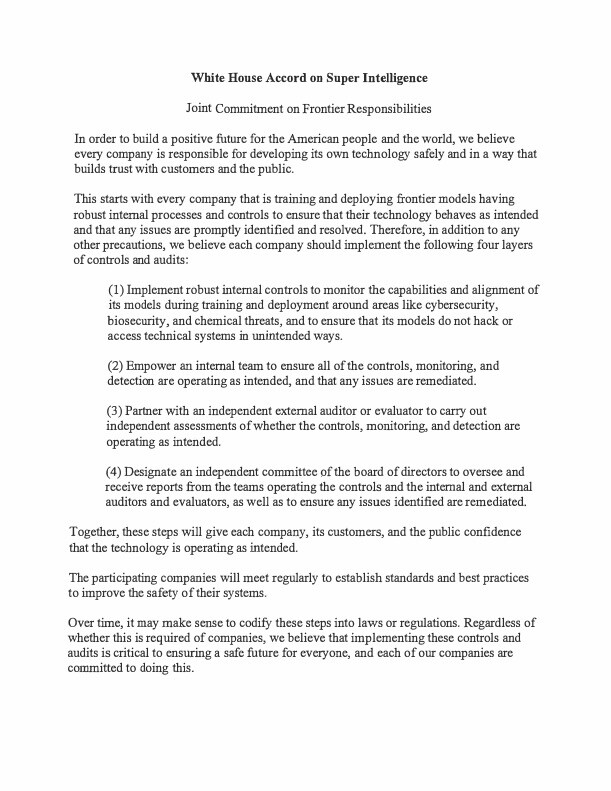
Amid escalating AI security incidents causing OpenAI to halt training and pause releases, Donald Trump continues to advocate for the AI industry to regulate itself as the best path to combat emerging risks when developing frontier AI.

In an agreement Tuesday, two dozen tech firms voluntarily committed to implementing controls recommended by the White House, including undergoing independent safety audits that will test whether firms’ internal controls, monitoring, and detecting are actually working. Key focuses for external reviews included “risks related to cybersecurity, biosecurity, chemical threats, and unintended actions by AI models.”

Firms also agreed to regularly meet to discuss best practices and set common AI safety standards and benchmarks. Among signers were leaders like Anthropic’s Dario Amodei, OpenAI’s Sam Altman, SpaceXAI’s Elon Musk, Nvidia’s Jensen Huang, Meta’s Mark Zuckerberg, and Alphabet/Google’s Sundar Pichai.

Read full article

Comments

© Kevin Dietsch / Staff | Getty Images News

❌